A dead battery usually picks the worst moment: a cold morning, a grocery store lot after dark, or a school pickup line where the engine cranks slowly and then goes quiet. To jump start a car, you connect two sets of cables in a specific order so the battery and alternator of a second vehicle can feed power to the dead one. The short answer is red to the dead battery's positive terminal, red to the donor battery's positive terminal, black to the donor's negative terminal, and the last black clamp to unpainted metal on the dead car, away from its battery.
Start the donor car and let both engines run for a few minutes. Then try the dead car. If it starts, remove the cables in reverse order and keep driving for 20 to 30 minutes so the alternator can put charge back into the battery. If it only clicks or cranks without catching after several tries, the battery is not the whole problem, and more cables will not fix it.
How do I know the battery is the real problem?
A weak battery usually gives warnings first. The engine cranks slower on cold mornings, the dome light dims when you turn the key, or the horn sounds tired. A single loud click when you turn the key often means the starter solenoid is getting power but the battery cannot supply enough current to turn the engine.
Rapid clicking, or dash lights that flicker and then die, also points to low voltage. Those symptoms are not proof of a dead battery, though. A corroded terminal or a failing starter can produce a similar sound, so look at the battery posts before you blame the cells.
A basic multimeter settles most questions in a minute. A fully charged 12-volt car battery usually reads about 12.6 volts with the engine off. A reading near 12.0 volts or lower means the battery is deeply discharged. If it drops back to that level the next morning, suspect a failing battery, a parasitic drain from a stuck light or module, or a charging problem.
What gear do you need before you connect anything?
Gather the right tools before you open the hood. A cheap set of jumper cables often fails on the first cold night, so buy a set with thicker copper wire. In wire gauge, a lower number means a thicker wire, and 4-gauge or 6-gauge cables are a common, practical choice for passenger cars and light trucks.
- A donor vehicle with a working 12-volt battery, parked close enough that the cables reach without stretching.
- Jumper cables with red and black clamps that bite into the metal of the battery posts.
- Safety glasses and gloves, because a damaged lead-acid battery can vent flammable hydrogen and leak acid.
- The owner's manual for both vehicles, which shows the positive and negative terminals and any remote jump post under the hood.
Park the donor car so the batteries are reachable but the two bodies do not touch. Set both parking brakes, put automatics in park, and switch off everything in both cars, including headlights, wipers, and the climate fan. Find the terminals before you start. Many batteries have plastic covers marked with plus and minus signs, and you can lift the cover if you need access.
How to jump start a car in the right cable order
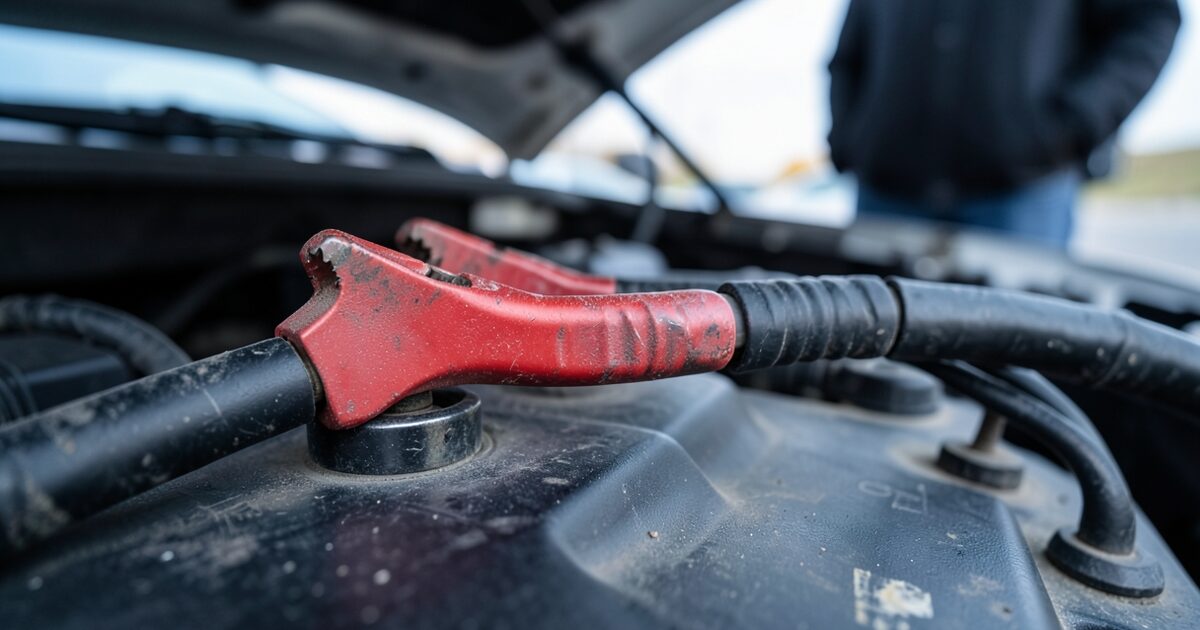
- Clamp one red cable to the positive (+) terminal of the dead battery.
- Clamp the other end of that red cable to the positive (+) terminal of the donor battery.
- Clamp one black cable to the negative (−) terminal of the donor battery.
- Clamp the other black cable to unpainted metal on the dead car, such as a bolt or an engine bracket, at least 18 inches from the dead battery.
The last connection is the one drivers most often get wrong. Clamping it to the dead battery's negative post puts a spark right beside the battery, where hydrogen gas can collect while the battery is charging. A bare metal ground point keeps any spark away from the battery and still completes the circuit. Keep the cables clear of fan blades, belts, and hot exhaust parts while you work.
Before you turn anything on, check that no clamp is touching another clamp or a metal part that is not the chosen ground. A stray contact can arc and weld a clamp to a post, which makes the next attempt harder.
How long should the donor car run before you try to start?
Let the donor car idle for two to five minutes before you try the dead car. That gives the donor's alternator time to push charge into the dead battery. If the dead car has been sitting in deep cold, a longer wait helps. Some drivers also raise the donor engine gently to about 2,000 rpm for a minute, which increases alternator output, but a steady idle works in most cases.
Crank the dead car for no more than about five seconds at a time, then wait a minute between tries. Long, repeated cranking drains both batteries and can overheat the starter. If the engine does not catch after three attempts, stop and check the connections instead of cranking again.
Once the dead car runs, remove the cables in the reverse order: black from the dead car's ground point, black from the donor's negative post, red from the donor's positive post, and red from the dead battery. Keep the clamps from touching one another while they are still connected to a live battery.
When will a jump start not fix the car?
A jump start only moves energy. It cannot repair a battery that has lost its ability to hold charge, and it cannot help a car with a bad starter or a dead alternator. These are the situations where you should stop and call for help.
- The battery is cracked, leaking, bulging, or smells like rotten eggs. Do not connect cables to it. Have it inspected and replaced.
- The battery is frozen or looks frozen. A frozen battery can rupture, so let it warm up and inspect it before any connection.
- The terminals are corroded or loose. Clean the clamp contact points with a wire brush and tighten the cable bolts before you try again.
- The car starts while jumped but dies once the cables come off. That usually points to a failing alternator rather than only a weak battery.
- You hear a single click, the dash stays bright, and nothing else happens. The starter or a poor connection is more likely than a flat battery.
Age matters too. Most car batteries last roughly three to five years, and heat and cold both shorten that range. A battery that is four years old and fails on a cold morning may simply be at the end of its life, even if the jump works.
What mistakes can damage a modern car's electronics?
Modern cars carry far more electronics than older vehicles, and a rushed hookup can cause damage beyond a flat battery. The most common error is reversed polarity, which means connecting a red clamp to a negative post. That can blow fuses and damage sensitive modules, including the engine control module and the body control module. If the car behaves oddly after a mistake, check the fuse box and the owner's manual before you assume the car is fine.
Another mistake is jumping a vehicle from a donor with a different system voltage. Most cars and light trucks run on 12 volts, but some heavy diesel trucks and commercial vehicles use 24 volts. Never jump a 12-volt car from a 24-volt truck, and never connect two different voltages even if the cable reaches.
Drivers also make errors with the timing. Leaving the cables on after the car starts, letting the donor engine shut off while the cables are still attached, or starting the donor with the clamps in the wrong order can all cause sparks or heat. Take the cables off in the reverse order, and do not lean over the battery while the engine is running.
Can you jump start a hybrid or electric vehicle?
Hybrids and electric vehicles still have a 12-volt battery that powers lights, locks, and many electronic modules, and that small battery is often the one that dies. Some hybrids have a clearly marked jump post or a specific ground point in the engine bay, and the owner's manual will show it. Others warn against jump starting entirely and send you to roadside assistance.
Only the 12-volt battery is involved. Do not attempt to connect cables to a high-voltage traction battery, and do not disconnect any orange high-voltage cables. If the manual gives no jump instructions, call a roadside service rather than guessing, because the high-voltage system is not something a driver should touch.
What should you do after the car starts?
Keep the engine running and drive the car rather than idling it in the lot. A drive of 20 to 30 minutes at steady speed gives the alternator more time to restore charge. Short trips and extended idling in cold weather do little to replace the energy a dead battery lost.
Consider a common scenario. A driver in Minneapolis leaves a 2016 Ford Escape in a parking garage at 8 degrees Fahrenheit with the dome light on all day. That evening the engine cranks slowly. A neighbor jumps it, the Escape starts, and the driver takes the highway home for 30 minutes. The next morning the car cranks slowly again. A free load test at many auto parts stores would show whether the battery still holds charge, and the driver should replace the battery if it does not.
If you record maintenance in CarDiary, add the battery replacement date, the cranking symptoms, and the jump date to your service log. That history makes it easier to tell whether the next slow start is a normal aging battery or a new fault.
Frequently asked questions
Is it safe to jump start a car in the rain?
Light rain is not a reason to skip a jump start. Keep the clamps and cable ends as dry as you can, avoid standing in puddles, and keep your hands out of the way of any moving part under the hood.
How many times can I try to start the car after a jump?
Try about three times, cranking for no more than five seconds each time and waiting a minute between tries. If the engine still does not start, the battery, starter, or connections need a closer look.
Will jump starting drain the donor car's battery?
A short jump rarely harms the donor battery, but leaving its headlights on or cranking the dead car for a long time can drain it. Keep the donor engine running while the dead car starts.
Should I leave the jumper cables connected until the car is running?
Yes. Leave the cables connected until the dead car runs, then remove them in reverse order, starting with the black clamp on the dead car's ground point.