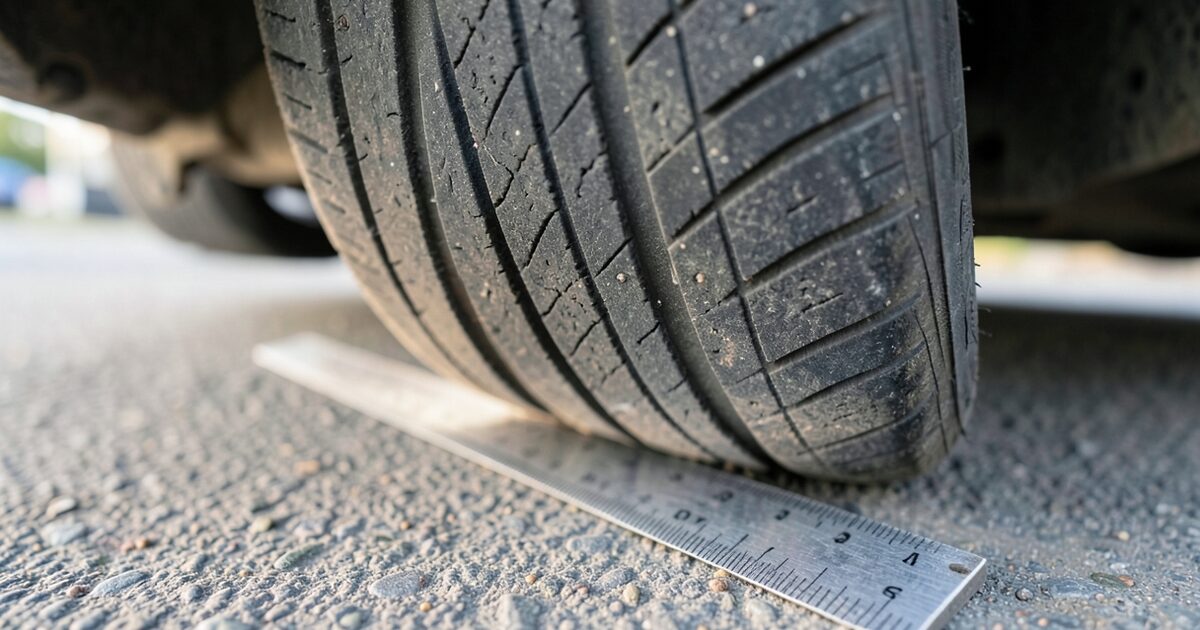
If you want to know whether your tires are ready for rain or snow, you can check tread depth in about five minutes with a penny, a quarter, or a cheap gauge. For most US drivers the short answer is this: a tire at 2/32 inch is at the legal floor in most states and should be replaced now, while many drivers replace at 4/32 inch before wet or snowy weather. This field guide shows how to measure, what the numbers mean for your next decision, and where people usually go wrong.
How do you check tire tread depth with a penny?
Take a penny and place it Lincoln-head first into a main tread groove, the deep channel that runs around the tire. Look at the coin. If the tread rubber covers the top of Lincoln's head, the tread is deeper than 2/32 inch. If you can see the top of his head with nothing covering it, the tread is at or below 2/32 inch, and the tire needs replacing.
Repeat the test in at least three grooves across the tread, not only the one that looks worst. Keep the coin upright so the reading is level. A quarter gives you a higher bar: insert Washington's head first, and if the tread does not reach above the top of his head, the tread is at or below 4/32 inch. That is the number to watch if you drive in rain or snow.
What is the legal tread minimum, and why replace at 4/32?
Most states treat 2/32 inch as the minimum tread depth for passenger tires, and that is the depth at which the small wear bars molded into the grooves become flush with the tread. The rule comes from state law rather than one federal number for every car, so the exact requirement depends on where you register the vehicle. If you need the citation for a specific state, start with the state DMV or the state vehicle code website.
The legal floor is not the same as safe for wet roads. AAA and tire testers have found that stopping distances on wet pavement get noticeably longer as tread wears down, which is why many drivers replace at 4/32 inch instead of waiting for the wear bars. For a daily driver, wet-road grip matters more than squeezing out the last few thousandths of an inch of rubber.
How much tread do you need for snow?
Sources do not agree on one number for snow. Some guidance treats 4/32 inch as the point where snow traction falls off sharply. Tire Rack describes 5/32 inch as reduced snow and ice performance and 6/32 inch as the point where snow traction starts to drop. A practical rule for a driver in a snow state is to plan a replacement before the tire reaches 5/32 inch, and to treat 4/32 inch as the latest you should drive on in snow.
Here is a worked example. A 2018 Subaru Outback has 6/32 inch in the center of each front tire but only 4/32 inch on the outer shoulders. The center looks fine from the driver's seat, yet the shoulders are the part that bites into slush at the edge of the lane. Before the first snowfall in a northern state, that car is a replacement candidate, because the worst groove decides the rating for that tire.
Where should you measure on each tire?
Measure across the tread, not in one spot. Check the center and both outer edges of each tire, which means the inner shoulder, the middle, and the outer shoulder. A single reading in the middle of the tire can hide a problem that shows up on the edge in wet or snowy weather.
- Check at least three grooves across each tire, including the center and both shoulders.
- Look for the wear bars, the small raised bridges across the grooves that sit at 2/32 inch.
- Repeat the check at each tire rotation, which many owners do every 5,000 to 7,500 miles, so you can see the wear trend instead of a single snapshot.
Write down the lowest reading you find, not the average. A tire that reads 5/32 inch in the center and 3/32 inch on one edge is a tire with 3/32 inch of usable grip in bad weather.
What does uneven wear tell you?
Wear on one shoulder usually points to alignment or inflation rather than simple age. Wear down the center often comes from overinflation, while wear on both shoulders usually means the tires have been run underinflated. Check the pressure against the placard on the driver's door jamb, because the number molded into the sidewall is the tire's maximum pressure, not the recommended pressure for your car.
Consider a 2019 Honda CR-V whose owner notices the left front tire at 3/32 inch on the outer edge while the rest of the tire reads 5/32 inch. Replacing only that tire is a poor fix, because a new tire next to a much more worn one can change how the car handles. A shop can check the alignment and the pressure first, and then the owner can decide whether to replace the pair on that axle. Keeping tires matched on the same axle is the usual advice for that reason.
Does tire age matter if the tread looks fine?
Yes. Tread depth tells you how much rubber remains, but rubber also hardens and cracks with age and sun exposure. Many tire makers suggest replacing tires after about six years even when tread is still good, and the age of any tire is printed on its sidewall.
Look for the DOT code, which ends in a four-digit group. The first two digits give the week the tire was made and the last two give the year, so 2619 means the 26th week of 2019. If a tire on a daily driver is older than six years, add it to the replacement list even if the penny test passes. That is especially true for a spare, which often sits unused and ages without wearing down.
What mistakes do drivers make with a tread check?
The most common mistake is measuring only the center groove, which hides shoulder wear that can make a tire unsafe in rain. A second mistake is using a worn coin or inserting it sideways, which gives a false reading. Drivers also tend to assume that deep tread means the tire is fine, even when the rubber is cracked or the date code shows a tire that is nearly ten years old.
- Measuring only one spot on the tire instead of at least three grooves.
- Waiting until the wear bars show, which means the tire is at the legal floor, not in the safe range for winter.
- Ignoring tire age and the DOT code on the sidewall.
- Checking tread once a year instead of at each rotation, so the trend never shows up.
- Replacing one tire on an axle with much deeper tread on the other, without checking alignment first.
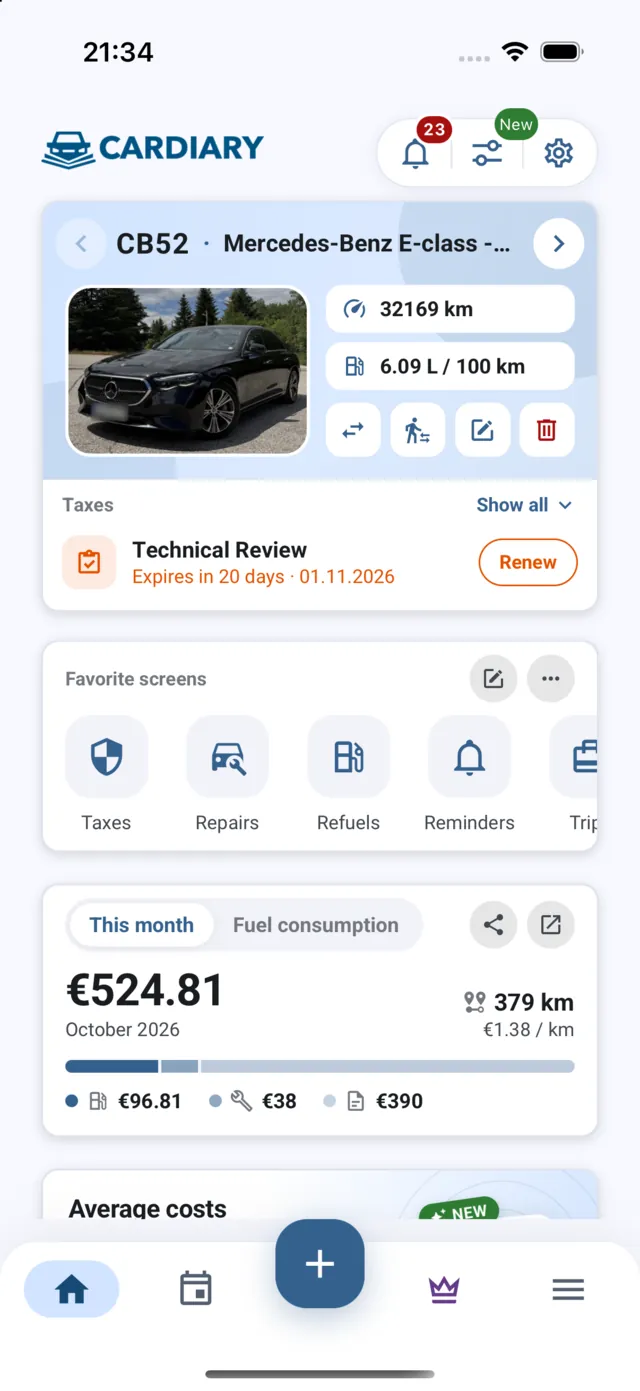
CarDiary works as a digital vehicle cost and deadline log that replaces spreadsheets, so you can store each tread reading and tire change beside your other repairs, though it does not measure tread itself.
Frequently asked questions
Is the penny test accurate enough?
The penny test is a quick check that tells you whether tread is at or near 2/32 inch. For a closer number, use a tread depth gauge, which reads in 32nds of an inch.
Can I drive on tires with 4/32 inch of tread?
It is legal in most states, but it is not ideal in rain or snow. Plan a replacement soon, and do it before the first wet or snowy stretch of the season.
Do winter tires need deeper tread than all-season tires?
Winter tires use their own tread design and rubber compound, so check their own wear bars and any snow rating marked on the sidewall. Do not assume one tread number applies to every tire.
Does a tread check replace a state inspection?
No. Some states include tires in their safety inspections and others do not, so check your state DMV for the rules that apply to your vehicle.