Headlines about AI data centers and California almond farms have turned water into a dinner-table debate, but most households already manage a smaller, predictable water budget on four wheels. Washing, topping off washer fluid, and periodic coolant service add up in gallons you can estimate with public EPA and Department of Energy guidance—not with a telematics box on your windshield.
Where automotive water actually goes
Passenger vehicles do not consume water the way a cooling tower does, yet they touch freshwater in three everyday ways: exterior cleaning, the windshield washer reservoir, and the ethylene-glycol coolant loop that protects the engine block. Manufacturing and fuel production also require water, but those gallons are embedded in the price of the vehicle and each gallon of gasoline; this guide focuses on what you control after the car is in your driveway.
Car wash gallons per visit (EPA WaterSense benchmarks)
The U.S. Environmental Protection Agency’s WaterSense program publishes industry averages for commercial vehicle washes. Self-service bays typically draw about 15 gallons of freshwater per vehicle, in-bay automatic washes about 43 gallons, and conveyor tunnel washes about 34 gallons, according to the agency’s WaterSense at Work guidance and supporting International Carwash Association research cited by the Department of Energy.
Professional sites that recycle rinse water through reclaim systems can cut freshwater demand sharply. DOE’s Federal Energy Management Program notes that with reclaim equipment, average freshwater use can fall to roughly 7.5 gallons at self-service locations and about 17 gallons on conveyor lines—still real consumption, just concentrated into fewer utility gallons.
Annual wash math for a typical US driver
An EPA WaterSense case study for San Antonio, Texas, used a planning assumption of nine car washes per year per vehicle—the national average cited by the International Carwash Association in that document. Applying WaterSense averages:
- Nine conveyor washes at 34 gallons each: about 306 gallons of freshwater per year.
- Nine in-bay automatic washes at 43 gallons each: about 387 gallons per year.
- Twelve monthly self-service washes at 15 gallons each: about 180 gallons per year.
Home washing with a hose and shut-off nozzle often lands near 75–100 gallons per session in water-utility models, so even two driveway washes a month can exceed a year of professional conveyor visits unless you capture runoff. Choosing a WaterSense-labeled or reclaim-equipped site is the fastest way to shrink that number without driving less.
Coolant and washer fluid: small volumes, high stakes
Engine coolant is mostly water and antifreeze mixed to protect against freezing and corrosion. A midsize sedan might hold roughly 2 gallons in the radiator and overflow tank combined; a full drain-and-fill during scheduled service replaces only part of that volume, while a neglected leak can drop levels slowly until the temperature gauge warns you. Most owner manuals call for coolant inspection at oil-change intervals and a system flush somewhere between 60,000 and 100,000 miles, depending on the formula (long-life orange coolant vs. conventional green).
Windshield washer fluid is the other recurring fill. A 1-gallon jug costs a few dollars at any auto-parts store and lasts weeks to months depending on season and road spray. Budget four to eight gallons a year if you commute on salted winter highways; half that in a dry Sun Belt city.
Why the data-center debate still matters to drivers
California policymakers are weighing whether hyperscale data centers must disclose potable water use, a response to rapid construction in water-stressed counties. OpenAI CEO Sam Altman argued on the Sources podcast that tens of thousands of ChatGPT queries might equal the water embedded in a single California almond; independent reviewers including PolitiFact and CalMatters note that published per-query estimates vary widely and that peak cooling demand on hot days can stress local utilities differently than steady farm irrigation.
For drivers, the parallel is local peak demand: washing every SUV on a Saturday afternoon spikes meter flow just as air-conditioning load spikes grid demand. Spreading washes across the week, fixing dripping hose bibs in the garage, and fixing a coolant leak promptly keeps your household from adding avoidable spikes—without changing how many miles you drive.
Fuel and electricity still dominate running costs
Water is rarely the largest line item on a cost log. At $4.00 per US gallon of regular gasoline, a 30-mpg sedan driving 12,000 miles per year burns about 400 gallons of fuel—roughly $1,600 before insurance, registration, or depreciation. Hybrids cut that fuel stack; a 50-mpg Toyota Camry Hybrid on the same mileage uses about 240 gallons, near $960 annually. You can model your own tank spend with the CarDiary MPG and fuel cost calculator using US gallons and EPA combined MPG figures from the window sticker or fueleconomy.gov.
Practical ways to lower your automotive water footprint
- Pick reclaim-equipped washes when available; ask whether freshwater use is under 40 gallons per vehicle, a common WaterSavers program threshold.
- Skip the open hose for routine rinses; use a bucket and a trigger nozzle if you must wash at home.
- Fix coolant leaks early; a sweet smell or pastel stain under the engine bay means lost fluid and potential overheating repair bills.
- Time winter washer fills before the first freeze so you are not dumping diluted summer mix on the driveway.
- Keep registration and inspection dates straight in the same log as fluid services; missed state deadlines can cost more than a year of car washes. The CarDiary inspection due date tracker stores those dates without GPS mileage capture.
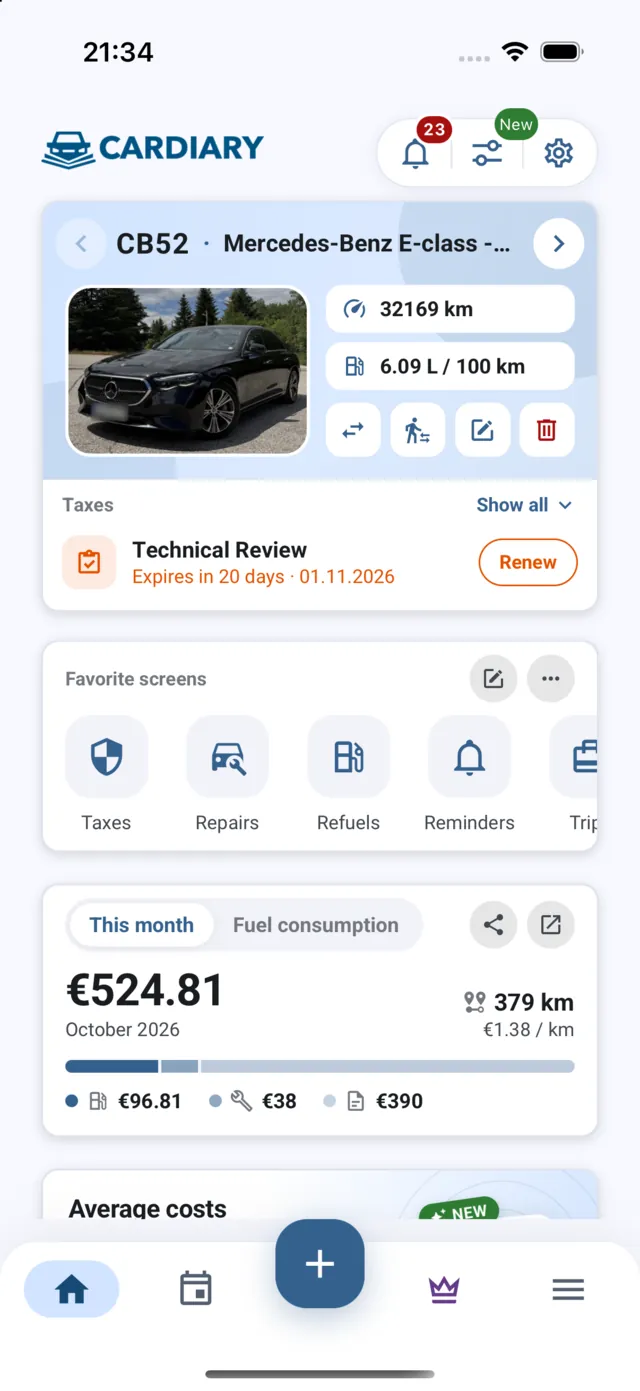
Recording coolant flushes and washer top-offs in CarDiary alongside fuel fill-ups makes it easier to see when a hose clamp or reservoir crack started costing you water—and when it is time for the next scheduled service instead of another emergency top-off.
What this does not cover
CarDiary is a digital vehicle cost and deadline log, not a state DMV portal, EPA registry, or utility billing system. It will not meter gallons at your car wash or certify WaterSense compliance. It simply replaces the spreadsheet most owners already use to remember why this year’s maintenance bill looked different from last year’s—whether the driver story is almonds, data centers, or a snowy commute that ate three jugs of washer fluid.