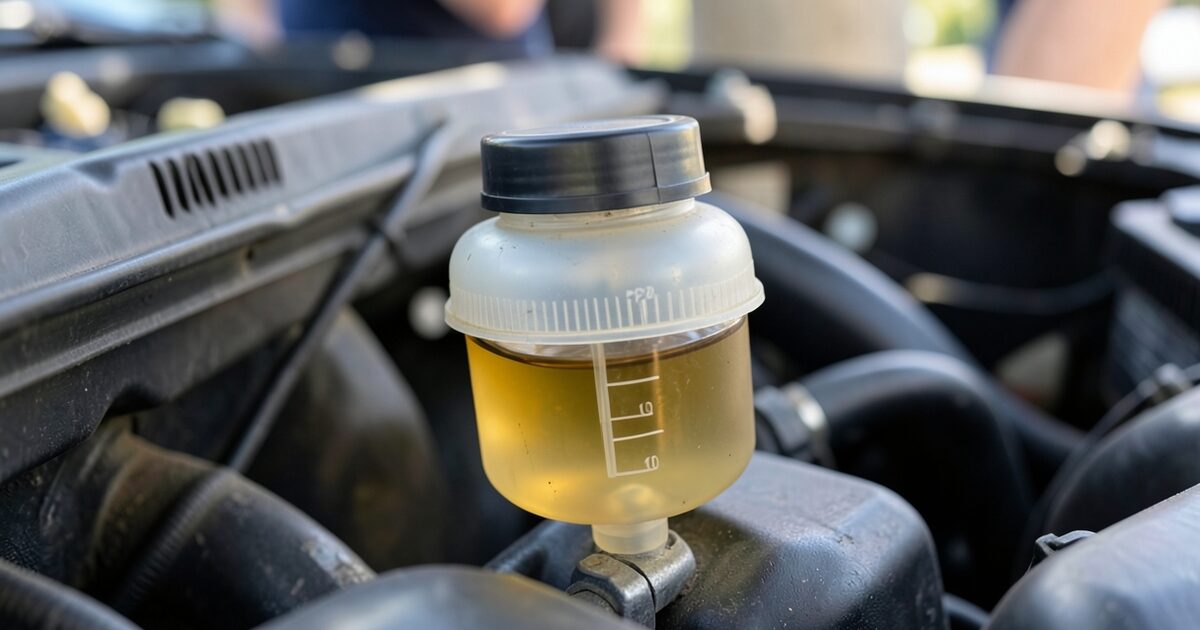
A brake fluid check takes about five minutes and tells you whether the fluid in your car is still doing its job. Park on level ground with the engine off, find the translucent reservoir on the master cylinder, and confirm the level sits between the MIN and MAX marks. Fluid that is clear to light amber is in good shape, while dark brown fluid or a level that keeps falling means you should look further. How often to replace it comes from your owner's manual, and many manuals list a full change every two to three years, though some use mileage instead.
How do you do a brake fluid check at the reservoir?
You do not need to open anything for a basic check. Open caps let moisture in, and brake fluid is hygroscopic, which means it pulls water from the air over time. Follow these steps on a cold engine:
- Park on level ground, turn the engine off, and let the engine bay cool.
- Find the reservoir on the master cylinder. On most US cars it sits at the rear of the engine bay on the driver's side, near the firewall, with a clear plastic body and a cap labeled with the fluid type.
- Read the level against the MIN and MAX marks on the side of the reservoir.
- Look at the color through the plastic without removing the cap.
- Read the DOT grade printed on the cap or reservoir, usually DOT 3, DOT 4, or DOT 5.1. DOT 5 is silicone-based and is not a drop-in swap for the glycol fluids.
- Write the date, level, and color in your notes so you can compare next time.
A slow drop in level is normal. As brake pads wear, the caliper pistons move out and the fluid fills the space behind them. A level that falls quickly between checks points to a leak, and that calls for an inspection, not a top-up. Check the level at each oil change so a sudden drop is easy to spot.
When does dark or low brake fluid mean a brake problem?
New brake fluid is clear to light amber. It darkens with age and use, and brown or black fluid usually means it has absorbed moisture or picked up debris from the system. Water matters because it lowers the boiling point. The federal standard in FMVSS No. 116 sets minimum dry boiling points of 205°C (401°F) for DOT 3, 230°C (446°F) for DOT 4, and 260°C (500°F) for DOT 5.1. Wet boiling points, measured after moisture has built up, are much lower, and that is the number that matters on a long downhill stretch.
When fluid boils under heavy braking, vapor compresses in the lines and the pedal feels soft or sinks. Drivers who descend long grades in the Rockies or the Sierra Nevada put more heat into the brakes than most city commuters do, so old fluid is a bigger risk there. A flush before a mountain trip is cheaper than a brake repair on the shoulder of a pass.
Warning signs that need a shop visit now
- The brake warning light is on, especially if the reservoir is below MIN.
- The level is below MIN, or it has dropped noticeably since your last check.
- The pedal feels spongy, or it sinks toward the floor when you hold it.
- The car pulls to one side under braking.
- You see wet fluid on a tire, a wheel, or the driveway under a wheel.
If the pedal goes soft, stop driving the car and call a tow. Do not top up the reservoir and keep going, because the top-up hides a leak that may get worse on the next stop.
How often should brake fluid be changed?
Start with the owner's manual, because it lists the interval for your car. Many manuals call for replacement every two to three years regardless of mileage, since moisture builds up even when the car sits. Some list a mileage figure, and a few describe the fluid as a check-and-replace-if-needed item. If you cannot find the interval, ask a dealer's service department for the number in the maintenance schedule.
Driving conditions change how fast the fluid ages. A commuter in Tampa who mostly drives flat city streets and a commuter in Denver who drives steep grades may both follow the same schedule, but the Denver driver should check the color more often. Humid climates can also speed moisture pickup, although the age of the car and the condition of its seals matter as much. CarDiary's service log can keep the flush date, mileage, and DOT grade beside your brake pad and rotor work, so the next change is a date on your calendar instead of a guess.
Should you top up or flush the brake fluid?
A top-up is the right fix when the level is low only because the pads have worn, the fluid is clear to light amber, and no leak exists. Use the DOT grade printed on your cap, from a sealed container, and fill only to the MAX mark on a cold system. Do not use fluid from an old bottle that has sat open in the garage.
A full flush replaces old fluid in the lines, calipers, and wheel cylinders. A shop or a careful do-it-yourselfer pushes fresh fluid through the system and bleeds each wheel until clean fluid comes out. Many manuals give a bleed order, and a common sequence is right rear, left rear, right front, then left front, starting with the wheel farthest from the master cylinder. Some cars have an ABS unit that needs a scan tool during bleeding, so a shop is the safer choice on those models.
Take a driver with a small SUV whose reservoir reads just above MIN, whose fluid looks light amber, and whose last flush was logged three years ago. The level fits normal pad wear, but the age of the fluid points to a flush. The right move is a full flush at the next service, not a top-up that only changes the number on the cap.
What mistakes do people make with brake fluid?
The most common mistake is mixing DOT 5 silicone fluid with DOT 3, 4, or 5.1 glycol fluid. The two do not blend, and a system that has run glycol fluid needs a complete change if you ever switch, not a top-up.
Another mistake is topping the reservoir to MAX when the pads are worn. When new pads go in, the pistons retract and the level rises, and a reservoir filled to the top can overflow. Brake fluid also strips paint, so wipe spills with a damp rag and rinse the area with water right away.
Some drivers buy a large jug and keep it for years. Glycol fluid absorbs moisture once the seal is broken, so buy the smallest sealed container that covers the job and recap the bottle tightly. Finally, do not assume a reservoir that looks full means the brakes are fine. A correct level can still hide old fluid that has gone wet.
Brake fluid check questions drivers ask
How often should I do a brake fluid check?
Check the reservoir monthly and before winter or a long mountain trip. Look at the level at every oil change as well.
Can I use DOT 4 instead of DOT 3?
Often yes, if the cap and owner's manual allow it, because DOT 4 is a higher grade. Never mix DOT 5 silicone fluid with glycol fluid.
Does low brake fluid always mean worn pads?
Worn pads are the usual cause of a gradual drop, but a leak can produce the same low reading. Have a shop inspect the lines and calipers before you assume it is pad wear.
Can a dashboard brake light come on for other reasons?
Yes. The light can come on when the parking brake is set or when the system detects a fault, so release the parking brake first and then have the brakes inspected if the light stays on.