Your tires carry their own build date. It is a four-digit code on the outer sidewall that shows the week and year the tire was made, and it takes about ten seconds to read. Most drivers never look at it, which is how a set of nine-year-old tires ends up on a car that otherwise looks well kept.
The question most US drivers type into Google is simple: how old is this tire, and is it too old to keep? The date code answers the first part. The second part depends on the vehicle manual, the tire maker's warranty, and the condition of the rubber. Many tire shops use about six years as the point to have a tire inspected and about ten years as the point to replace it, even when the tread still looks deep.
Where is the DOT date code on a tire?
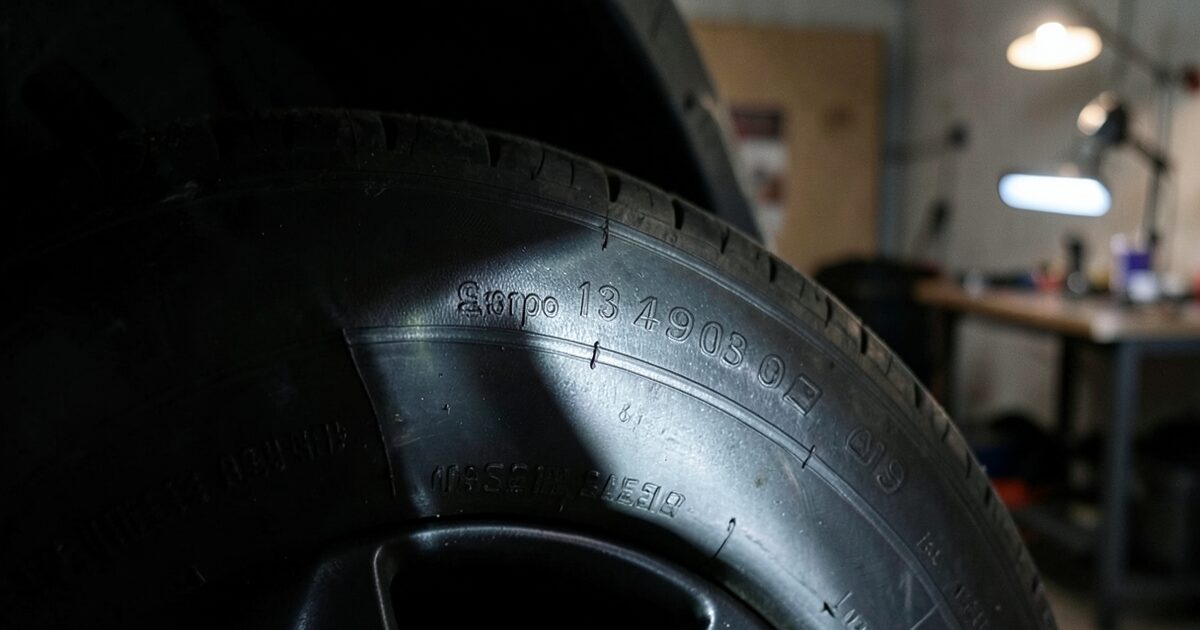
Every tire sold in the United States carries a DOT number. It starts with the letters DOT, then lists plant, size, and manufacturer codes, and the last group of digits is the date code. Look on the outer sidewall, the side that faces out when the wheel is mounted on the car.
The date code is often in a small recessed box or oval, and the digits can be hard to read in a dim garage or a parking lot at night. Use a flashlight and wipe off road grime with a damp cloth. Avoid scraping the sidewall with a fingernail or a key, because that can damage the rubber and the marking.
Check all four tires and the spare. A single replacement tire is often a few years newer than the rest of the set, and a mixed set is common after one flat. Write down each tire's code instead of assuming the set matches.
How do I read the four digits in a tire date code?
For tires made since 2000, the date code is the last four digits of the DOT number. The first two digits give the week of manufacture, from 01 to 52, and the last two give the year. A code of 1422 means the 14th week of 2022, which falls in early April.
The week matters as well as the year. A tire made in week 01 and one made in week 52 of the same year differ by almost twelve months, and that gap can decide which checkpoint a tire has reached.
Tires made before 2000 show three digits, and the year digit repeats every decade. A code like 287 could mean 1987 or 1997, so the code alone does not give a clear date. Any tire with a three-digit code is far past the age where it belongs on a car, so retire it.
- Find the DOT number on the outer sidewall.
- Take the last four digits, or the last three if the tire is pre-2000.
- Split the four digits into week (first two) and year (last two).
- Count the years from that date to today, then compare the result with the limits in the next section.
How old is too old for a tire in the US?
I could not verify a federal age limit for passenger tires in the United States. The National Highway Traffic Safety Administration has said that tire age matters alongside tread, and that heat speeds up aging. The working limits come from the vehicle manual, the tire maker's warranty, and what a tire inspection finds.
Most shops use two checkpoints. At about six years, have a shop inspect the tire for sidewall cracks, bulges, and stiff rubber. At about ten years, replace it even if the tread looks good.
Climate changes the picture. A car parked outdoors under a summer sun in Phoenix or Houston ages its tires faster than a car kept in a garage in Portland, so the same date code can carry different risk. Drivers in hot states have good reason to schedule the inspection a year earlier than the six-year mark.
What should I do when a tire is six years old or more?
A driver in Phoenix bought a used 2019 Honda CR-V last year with its original tires still on it. The date code on all four reads 2817, which is week 28 of 2017. In November 2026 those tires are about nine years old, so the six-year inspection is overdue and the ten-year replacement point is close.
The shop finds fine sidewall cracking on the rear pair and recommends replacing the set. Many shops suggest replacing tires in axle pairs at minimum, and all four is the safer choice on any all-wheel-drive car. The driver asks the shop to write each old tire's code on the invoice, which is a habit worth copying.
Use the visit to ask the right questions:
- Ask for the date code of every tire, including the spare.
- Ask for a sidewall inspection, not only a tread reading.
- Ask whether the replacement should be a pair or a full set.
- Ask for the install date to be written on the invoice.
A digital log such as CarDiary can hold each tire's install date and set a reminder for the six-year inspection, which is easier to keep than a note in the glovebox.
Are spare tires, stored tires and sale tires still safe?
Spare tires count too. A spare that has sat under the trunk floor for eight years can be older than the tires on the car. A temporary spare, often called a donut, usually carries a printed speed and distance limit, commonly 50 or 70 miles per hour, so read that label when you check the spare.
Winter tires stored in a shed or basement age during the off-season too. Write each set's date codes on the storage bin and check them each fall. Keep stored tires out of direct sunlight and away from heaters, since heat and light speed up rubber aging.
Closeout or warehouse tires can be newer than you expect, or several years old in the back of a shop. Ask for the date code before paying, and walk away from a tire that is older than the shop's own limit. A tire that has never been mounted still ages in its box, even when the tread looks new.
What mistakes keep an old tire on the car?
Most problems come from a few habits rather than from not knowing how to read the code.
- Judging age by tread alone. A tire with deep grooves can still be too old, because aging rubber cracks even when the tread is thick.
- Checking only the tire that looks worst. Age varies within a set, and the oldest tire sets the limit for its axle.
- Ignoring the spare. A spare kept in the trunk for years can be unusable exactly when a flat happens.
- Confusing the build date with the install date. The code shows when the tire was made, not when it was mounted, so a tire can sit in a warehouse for a year before it reaches your car.
- Relying on the penny test alone. Insert a penny Lincoln-head-first into the groove. If you can see the top of Lincoln's head, the tread is at or below 2/32 inch, the legal minimum in most states, and the tire needs replacing whatever its age.
Frequently asked questions about tire date codes
Where is the tire date code on a US tire?
It sits on the outer sidewall at the end of the DOT number. Tires made since 2000 show four digits, and older tires show three.
Does the date code show when the tire was installed?
No. It shows when the tire was manufactured. Write the install date down at the shop so you have a clear starting point.
Is there a federal age limit for passenger tires?
I could not verify one. Follow your vehicle manual and the tire maker's guidance, and ask a tire shop to inspect any tire past about six years.
Can a tire with deep tread still be too old?
Yes. Aging rubber can crack and separate even when the grooves are deep, so check the sidewall as well as the tread.