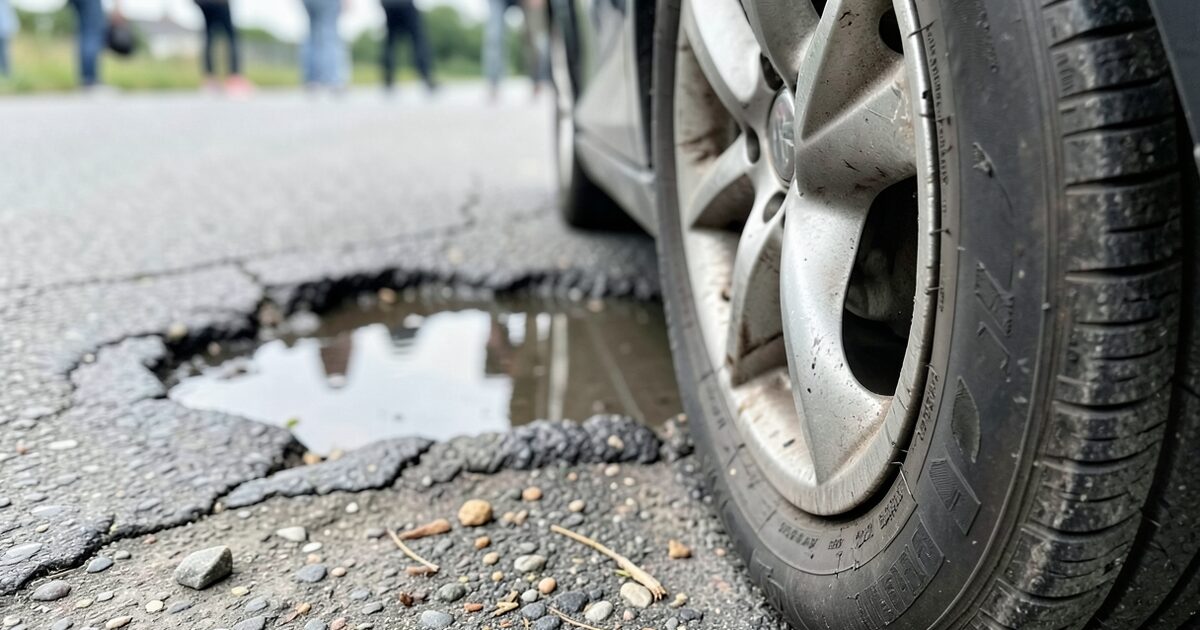
Pothole damage to your car is often hidden. One hard hit can bend a wheel, unseat a tire bead, or knock a suspension part out of alignment, and the car may still drive almost normally. If the steering pulls, a warning light comes on, or you hear a new knock, stop and inspect before you drive farther. If nothing feels different, a check in the next day or two is still the safe default, because a bent rim can leak air slowly for days.
The question most drivers type after a hit is simple: is the car safe to drive, and what should I check before I call a shop? For a hit at normal city speed with no light, vibration, or pull, a careful visual check in a safe spot is usually enough, followed by a shop visit within a few days. Anything else means you treat the car as unsafe until a technician has looked at it.
Check the tire and wheel before you drive far
Pull over somewhere flat and out of traffic, then look at the tire sidewall. A bulge, a cut, or a split means the internal cords are damaged. That tire needs replacement, not a patch, and it should not go on the highway.
Next, check the rim. A bent rim often shows up as a slow leak or a wobble at highway speed. Run a hand along the inside edge of the rim where it meets the tire. A flat spot or a sharp lip can catch your fingers even when you cannot see it from outside.
Then check the pressure with a gauge. The recommended cold pressure is on the placard inside the driver's door jamb, not on the tire sidewall. The number on the sidewall is the maximum the tire can hold. Low pressure after a hit can mean a slow leak or a bead that has shifted off its seat.
Take a 2018 Honda Accord driver who hits a deep pothole on a city street at about 35 mph. The tire looks fine, but the gauge reads 24 psi, while the same tire read 35 psi the day before. The bead has partly unseated and the rim has a bend. Driving another 20 miles on the highway risks a sudden air loss at speed, while stopping at the first tire shop turns a $20 valve and rim check into a same-day fix.
Which warning lights and sounds mean stop driving
Some dashboard lights point straight at pothole damage. Treat these as a reason to stop or call a shop before you drive on:
- The tire pressure (TPMS) light that stays on or comes on after the hit. Cold mornings also trigger it, so recheck the pressure before you assume the sensor is the problem.
- The ABS, traction control, or stability control light. A hit can damage a wheel speed sensor or its wiring, and these systems may then fail to help on a wet or icy stop.
- The airbag (SRS) light. A steady airbag light means the system needs a scan, and you should not ignore it.
- A flashing check engine light. A flashing light means an active misfire, so stop as soon as it is safe.
Sounds matter as much as lights. A clunk over bumps often points to a loose control arm bushing, a sway bar link, or a strut mount. A grinding or scraping sound when you turn can mean a damaged brake shield or caliper. A hum that rises with speed and changes when you swerve left or right often means a wheel bearing that took the impact.
Which suspension parts take the hit from a pothole
A pothole usually loads the car from below and to one side, so the parts that fail first are the ones at the corners of the suspension. Ask the shop to inspect these specific items:
- Struts and shocks, checked for oil seeping down the body and for a bounce that keeps going after you press a corner.
- Lower control arms and their rubber bushings, checked for cracks, play, or a torn boot.
- Ball joints and tie rod ends, checked for play when a technician rocks the wheel by hand.
- Sway bar end links, which often bend or snap on a hard side hit.
- Wheel bearings, checked for play and for noise on a road test.
These parts matter because they set the wheel angles. A worn tie rod end changes toe, which can chew a tire in a few thousand miles. A bent control arm can make an alignment impossible to hold, so the cheapest fix is not always the right one.
Do you need a wheel alignment after hitting a pothole?
Yes, when the steering wheel sits off-center, the car pulls to one side on a straight, flat road, or the tire wear is uneven. Feathering across the tread or heavy wear on one edge both point to wheel angles out of spec. An alignment after a hard hit is often a check first, not an automatic service.
Ask the shop for a printout of the alignment readings before and after any adjustment. The printout shows camber, caster, and toe for each wheel, and it lets you compare the readings with the vehicle's published specifications. If the shop cannot bring the numbers into range, a bent part is the likely cause, and an alignment will not solve it.
Low-profile tires on larger wheels are more vulnerable. A 20-inch wheel with a thin sidewall can bend where a 17-inch wheel with a taller sidewall would only flex. Most drivers who hit a pothole on a 20-inch rim should expect a rim inspection even when the tire holds air.
How to document pothole damage for a city or county claim
Before you file, find out who maintains the road. A city street, a county road, and a state highway often belong to different agencies, and each has its own claim form. Many states require a written notice of claim within a short window, sometimes only a few months, so check the agency's claim page early and do not wait for the shop to finish the repair.
Documentation decides most claims. Follow these steps:
- Photograph the pothole with an object for scale, such as a coin or a tape measure, and include the nearby street sign or cross street.
- Photograph the damaged tire, rim, and suspension part from several angles, and note the date, time, speed, and weather.
- Ask the shop to describe the damage on the written invoice and to state that it is consistent with a pothole impact.
- Ask the shop to keep the damaged part until the claim is decided, and get a photo of it before it goes in the scrap bin.
- Report the pothole through your city's 311 service or the state DOT line so it gets repaired and your report is on record.
Keep all of it in one place. Logging the repair date, the invoice, and the photos in the CarDiary service log means you are not searching a glovebox for a receipt months later when an adjuster asks for it.
Mistakes people make after a pothole hit
The most common mistake is driving on a low tire because it still looks round. A slow leak can drop the pressure enough to overheat the tire on a long drive, so recheck it the next morning and again after a few days.
The second mistake is blaming the cold for the TPMS light. Pressure drops roughly 1 psi for every 10 degrees Fahrenheit the air gets colder, so a light on a freezing morning may be real. Inflate to the door placard figure and see whether it stays off.
Drivers also skip the alignment because the car still drives straight. A straight car can still have a bent toe link that will wear a tire in a few months. Another mistake is throwing away the bent wheel before a claim is decided, and a third is not reporting the pothole, so the next driver hits it too.
A tire that fails without any pothole hit is a different case. If a tire comes apart or a sidewall separates while the car is in normal use, report it to NHTSA at nhtsa.gov so the failure is part of the federal record, and keep the tire for the investigator.
Pothole damage questions drivers ask
Can a pothole damage a car enough to total it?
It is rare. Most damage is limited to a tire, a rim, or a suspension part, which a shop can repair. A badly bent frame or a severe airbag fault is less common, but a car with those symptoms should be inspected before it is driven.
Is a tire with a bulge safe to drive?
No. A bulge means the internal cords are broken, and the tire can fail without warning. Replace it, and do not use a patch or plug on a damaged sidewall.
Does insurance cover pothole damage?
Collision coverage usually applies to a pothole hit, minus your deductible. Comprehensive coverage often does not, so check your policy. A claim can affect your premium, so compare the repair estimate with your deductible before you file.
How long do I have to file a claim against a city?
The deadline depends on your state and on the local government. Some require written notice within a few months, while others allow longer. Check the claim page for the city, county, or state DOT that maintains the road before you wait for repairs to finish.