The fastest legal speed on some Missouri interstates is about to rise, but a new law does not change a single sign by itself. A driver who sets cruise control to 75 mph on any rural interstate because of a headline is guessing. Missouri's change lifts the ceiling on eligible rural highways, and the Missouri Department of Transportation (MoDOT) decides which stretches qualify and when the posted limit actually moves.
This explainer covers what the law changed, which stretches MoDOT has selected so far, why the sponsors point to newer car safety features, and how to confirm the limit on a trip before you rely on cruise control.
What Missouri's 75 mph law changed
The measure is Senate Bill 1408, sponsored by Sen. Jamie Burger. It passed the legislature in the spring, Gov. Mike Kehoe signed it in July 2026, and it took effect August 28, 2026. Before that date, 70 mph was the top posted speed on Missouri's rural interstates, and lawmakers described the change as the state's first speed limit increase in more than three decades.
The law does not raise every road automatically. It gives MoDOT the authority to set 75 mph on eligible rural interstates and freeways, and the department must evaluate each stretch first. A road that qualifies can stay at 70 mph, and MoDOT has said it will keep watching safety data and may lower a limit back if crashes rise.
For a driver, the practical change is narrow. Your legal speed is still the number on the sign you pass, and the Missouri State Highway Patrol has told drivers to obey posted signs. The headline number matters less than the sign at the next mile marker.
Which Missouri stretches are moving to 75 mph first
MoDOT announced its first selections after several weeks of review. Reporting on the list names three western routes: Interstate 29 from Exit 56 in Andrew County to just south of the Iowa border, Interstate 35 from the northern city limits of Cameron to just south of the Iowa border, and Interstate 49 from the Arkansas border north to Exit 24, plus a separate piece from Exit 56 north to Nevada.
MoDOT chose those segments based on traffic volume, truck volume, current speed data, crash history, terrain, road design, and other factors. Crews are expected to begin replacing speed limit signs this fall. Earlier reporting had named Interstate 55 in southeast Missouri as a possible candidate, but the list reported so far does not include it, so check MoDOT's current map before assuming a route is covered.
If your route is outside those corridors, the limit does not change because the law passed. A long trip across the state may pass through both 70 and 75 segments, and each sign controls only its own stretch. Plan the trip around the signs you will actually see, not the summer headlines.
Why sponsors cite safety tech, and what MoDOT counters
Sen. Burger has pointed to adaptive cruise control, blind-spot detection, and automatic emergency braking as reasons a higher limit makes sense on modern cars. The argument is that today's vehicles hold a set speed, watch adjacent lanes, and brake harder than the cars that were common when the older limits were written.
MoDOT takes a more cautious view. The department cites an Insurance Institute for Highway Safety study that ties a 5-mph increase to an 8.5 percent rise in fatal crashes on interstates. Critics have also raised concerns for drivers and highway workers, and the department says it weighs crash history and speed data rather than vehicle features alone.
Driver-assistance features do not change the posted limit or the penalty for exceeding it. Automatic emergency braking is designed to reduce the severity of a sudden stop, and adaptive cruise control follows the traffic ahead. Neither one makes a higher legal speed appropriate for a particular stretch by itself.
How to confirm the speed limit on your route
Treat the sign, not the news, as the rule. Use this order each time you enter an interstate segment:
- Read the posted limit at the on-ramp and again at every point where the road changes from one segment to another.
- Check MoDOT's published selections or traveler information before a trip on I-29, I-35 or I-49, since signs are being changed this fall.
- Set cruise control to the posted limit only after you see the sign, and reset it when a new sign appears.
- Compare your speedometer with any navigation speed display. Navigation-based limits can lag behind new signs, so the posted sign wins.
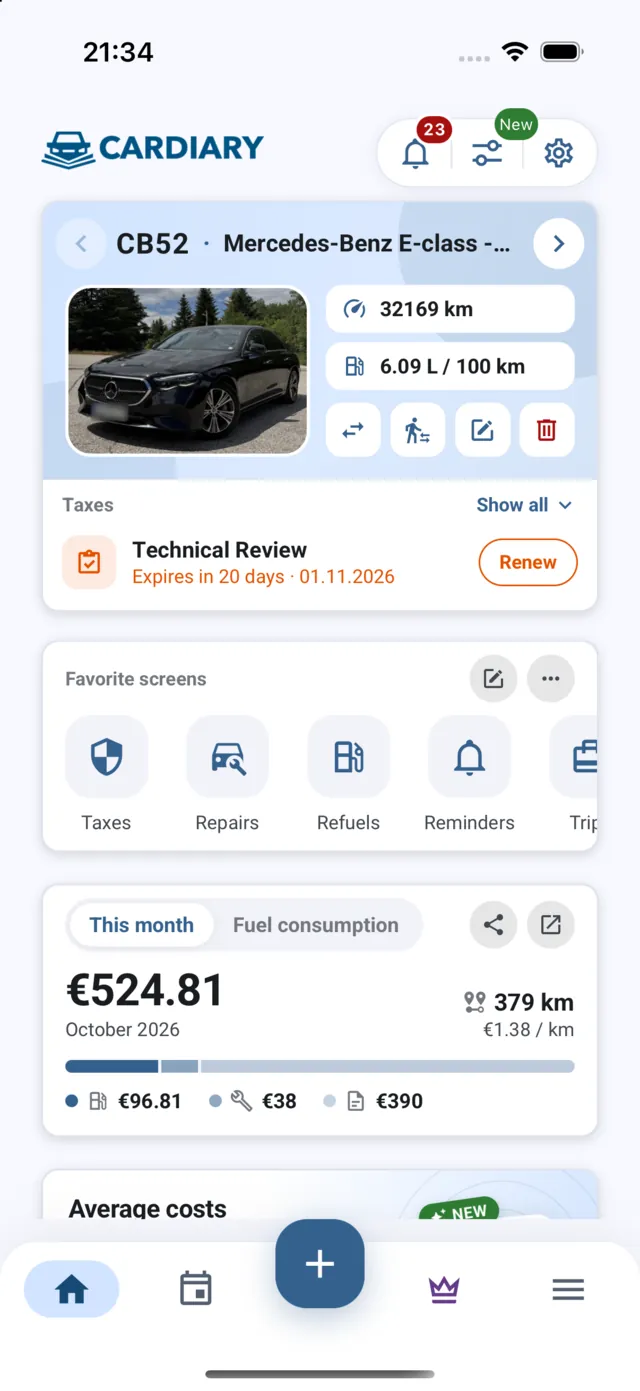
Many owners keep brake, tire, and registration dates in CarDiary, a digital vehicle cost and deadline log that replaces a spreadsheet, so the pre-trip check is written down before a long highway run.
A worked example on I-29 in Andrew County
Picture a driver heading north on I-29 in a 2022 Honda CR-V with adaptive cruise control. The driver reaches the stretch that starts at Exit 56 in Andrew County with a 70 mph sign still in place, sets the cruise at 70, and keeps it there. A 75 mph sign appears only after crews have replaced the sign on that segment.
Now suppose the same driver is on a trip that began in Kansas City and is nearing the Iowa border. The Missouri limit applies while the car is inside Missouri, and the next state's rule takes over at the line. The driver checks the sign on the far side before raising the set speed, because a neighboring state's posted limit can differ from Missouri's.
The lesson is simple. The car can hold 75 mph, but the sign decides whether the driver is within the law. The safe habit is to change the cruise setting when the sign changes, not when a news story or a travel app suggests it.
Mistakes drivers make after a speed limit change
The most common error is assuming that every interstate became 75 mph once the law took effect in August. The law sets up the option, but MoDOT still has to evaluate and sign each stretch. Drivers who skip that step end up speeding on roads that remain at 70.
- Assuming every interstate became 75 mph after the law took effect.
- Carrying a higher set speed onto a stretch that is still posted at 70 after a sign was removed or changed.
- Treating an old travel app or a memory of last month's trip as current when the sign has not been updated yet.
- Forgetting that MoDOT said limits could be lowered back if safety data shows problems.
Another frequent mistake happens with a rented or borrowed vehicle. Its cruise and speed display setup may differ from the car you normally drive. The sign is the rule for every vehicle, whatever the dashboard shows.
Frequently asked questions about Missouri's 75 mph limit
Is the speed limit 75 mph on all Missouri interstates?
No. The law lets MoDOT raise eligible rural stretches to 75 mph, and only the segments MoDOT selects get the higher limit. Every other road keeps its posted limit.
When did the 75 mph law take effect?
The law took effect August 28, 2026. The new limits apply only where MoDOT has posted them, and signs on the selected stretches are scheduled for replacement starting this fall.
Can I get a ticket for going 75 mph on a road still posted at 70?
Yes. The posted limit is the enforceable limit, and the Missouri State Highway Patrol has told drivers to obey the signs.
Why is my interstate still 70 mph?
Eligibility depends on MoDOT's engineering review of crash history, traffic and truck volume, terrain, and road design. Until MoDOT selects and signs a stretch, the limit stays at 70 mph.