Cold weather tire pressure changes often show up as a warning light on the first truly cold morning of the season. The light means at least one tire is 25 percent or more below the pressure the carmaker recommends for your car. Most cold-weather pressure loss is ordinary air contraction rather than a leak, but a tire that low can still affect handling, braking, and wear.
This guide answers the question US drivers search most often: why the light came on when it is cold, which number to inflate to, and what to do in the driveway or on the shoulder. It also covers a common mistake, which is inflating to the number molded into the tire sidewall. That figure is the maximum the tire can hold, not the target for your car.
Why does tire pressure drop when it gets cold?
Air inside a tire shrinks as it cools, so pressure falls even when the tire holds perfectly. A common rule of thumb is about 1 psi for every 10 degrees Fahrenheit change in temperature. A car parked in a 70-degree garage and driven out to a 20-degree driveway can lose roughly 5 psi from temperature alone.
That number is an approximation. Tire age, valve leaks, bead seating problems, and small punctures add to the loss, and cold weather simply makes an already marginal tire show up on the dashboard. The reverse matters too. A tire that has been running on the highway reads several psi higher than its cold value, so a reading taken after a long drive can make a low tire look fine.
Cold snaps also tend to arrive with the first long winter trips, shorter days, and more hours parked in unheated lots. Those are the mornings when drivers notice the light for the first time. Checking pressure before the first hard freeze gives you time to find a slow leak before the car sits in the cold for weeks.
What does the TPMS warning light actually mean?
Passenger vehicles sold in the US have had to include a tire pressure monitoring system since the 2008 model year. Federal rules under FMVSS 138 require the system to warn the driver when a tire is 25 percent or more below the recommended cold pressure. The light does not say which tire is low or how low it is, so the first job is a manual check of all four tires.
Systems come in two types. Direct systems use a sensor inside each wheel that reports pressure. Indirect systems infer low pressure from wheel speed sensors and the anti-lock brake system. An indirect system can miss a tire that is low on all four corners at once, which is one reason a gauge check is still needed after a cold snap.
The light can also blink. On many vehicles, a blinking TPMS light for about a minute, followed by a steady light, signals a system fault rather than low air. The owner's manual for your model explains the exact pattern, because the signals vary by manufacturer.
Where do I find the right tire pressure for my car?
The correct number is the cold recommended pressure set by the carmaker for your tire size and typical load. In most cars you will find it on a placard, usually on the driver's door jamb or door edge. The owner's manual and, on some models, the fuel filler door label list the same figure.
Do not use the number molded into the tire sidewall. That figure, often printed as a maximum such as 44 or 51 psi, is the highest pressure the tire can safely hold, not what the car should run. Running at that level gives a harsher ride, less tire contact on wet pavement, and wear concentrated in the center of the tread.
Check whether the placard lists different numbers for front and rear. Some pickups and SUVs specify a higher rear pressure when they carry a heavy load. Use the figure that matches how you normally drive. If you have changed to a winter tire with a different size or load rating, confirm the pressure for that tire in the manual or with the installer.
How do I check tire pressure correctly in cold weather?
Check the tires when they are cold, before the car has been driven far. Cold readings are the ones the placard refers to, so a tire checked after a commute will read higher than it really is when it sits overnight.
- Wait until the car has been parked for at least three hours, or has been driven less than a mile, so the tires are at ambient temperature.
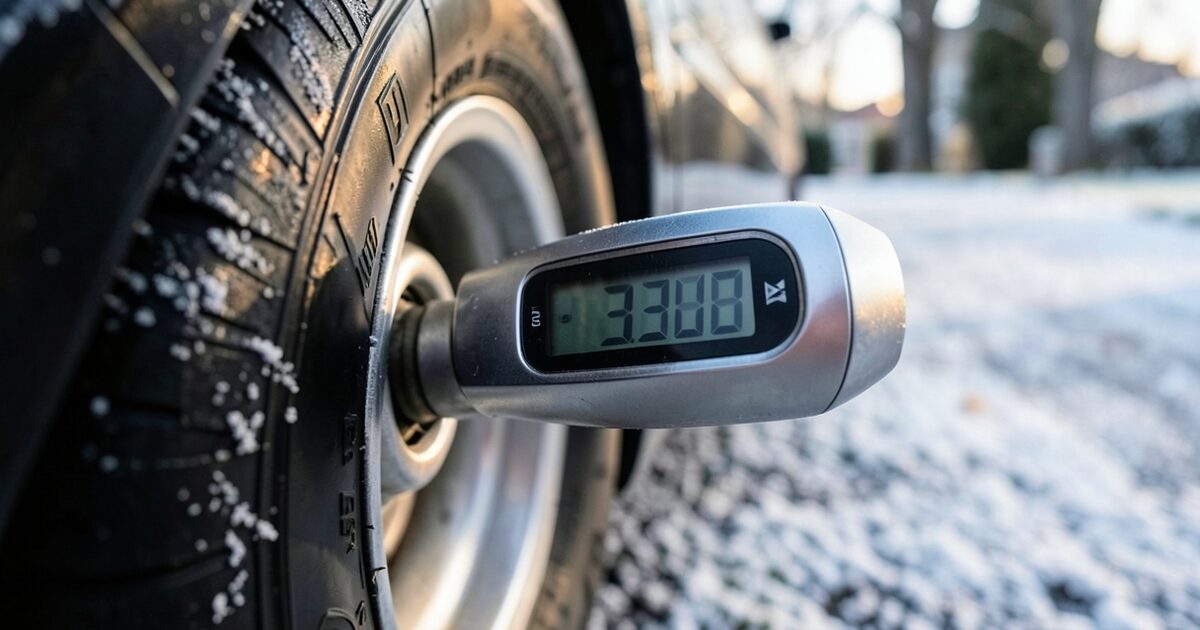
- Remove the valve cap and press a digital or dial gauge squarely onto the valve stem. Gas station air machines can be inaccurate, so use your own gauge.
- Compare each tire to the placard value, not to the number on the sidewall.
- Add air in short bursts and check the gauge after each one until the tire reaches the placard value.
- Check the spare. A temporary spare often has its own pressure printed on the tire, and that number is usually higher than the placard value for the car.
- Recheck in a week or two. A tire that keeps losing air over that period has a leak that needs a repair shop, not more air.
Do the check in a sheltered spot, away from wind and snow, and keep the gauge in the glove box so it is ready for the next cold morning. A gauge that reads within a psi or two of your neighbor's is good enough for routine checks.
What should I do when the light comes on while I am driving?
Watch the light and the car. If the light comes on and stays on, find a safe place to stop and look at each tire. A tire that is visibly flat, or that makes a flapping or thumping sound, needs immediate attention. Driving on a flat or near-flat tire can damage the tire and wheel and can make the car harder to control.
Consider a worked example. A midsize SUV has a 35 psi placard. On a 15-degree morning, the front left tire reads 27 psi after a night in the driveway. That is about 23 percent below the placard, so the light may not be on yet even though the tire is clearly low. Add air at the next gas station, then recheck the tire over the next few days. If the same tire needs air every few days, have a shop check for a nail or a valve problem.
At 35 psi, a tire 25 percent low sits near 26 psi, so on that car the light usually appears somewhere below that level. Once the tire is back to the placard value, some vehicles need a reset from the dashboard menu or a button under the steering wheel before the light turns off. Read the manual before you assume the car is still warning you.
What are the common mistakes with cold weather tire pressure?
- Inflating to the sidewall maximum instead of the placard value, which can make the car ride harshly and wear the center of the tread faster.
- Checking tires right after a highway drive, then adding air to a tire that was already at the correct cold pressure.
- Assuming all four tires are fine because one was topped up or because the light went off on its own.
- Skipping the spare, which may have lost air over months and is the only tire left after a flat in bad weather.
- Forgetting that a TPMS reset may be needed after inflation, so the light stays on and gets ignored.
- Trusting an unverified gas station gauge for every check instead of confirming the reading with your own.
Most of these mistakes come from treating tire pressure as a one-time job. A tire that was right in October can be several psi low by the first freeze, so the check belongs on the same routine as the oil or the washer fluid.
How can I keep a tire pressure record that is useful later?
Tire checks are easy to forget once the light goes off. A record of dates, cold pressures, odometer readings, and tire replacements helps when a leak returns or a shop asks how the tire has been maintained. Note the placard value you used, the tire location, and whether the reading was taken cold.
If you already keep tire-rotation dates in a spreadsheet, CarDiary can hold those service entries and reminder dates in one digital log, though it is a personal record rather than an official inspection or registration file.
Frequently asked questions about cold weather tire pressure
Can I drive with the TPMS light on?
Yes, for a short trip to a safe place or a gas station, if the tire is not visibly flat and the car handles normally. Inflate it to the placard value and recheck it soon. Do not drive long distances on a tire that keeps losing air.
Why does the light come on only in the morning?
Overnight cold lowers the pressure in every tire, and the drop can push one tire below the warning threshold. The light often goes off after the tires warm up on the drive, which is why the problem can seem to come and go.
Should I inflate my tires to the sidewall pressure in winter?
No. The sidewall number is the maximum the tire can hold. Use the placard value for your car in winter and summer unless the carmaker or your tire installer gives a different number for a specific tire.
Does a TPMS light always mean a leak?
Not always. Temperature drops, a slow leak, or a damaged valve can all cause low pressure. If one tire needs air repeatedly, a tire shop should inspect it for a puncture and check the valve stem.