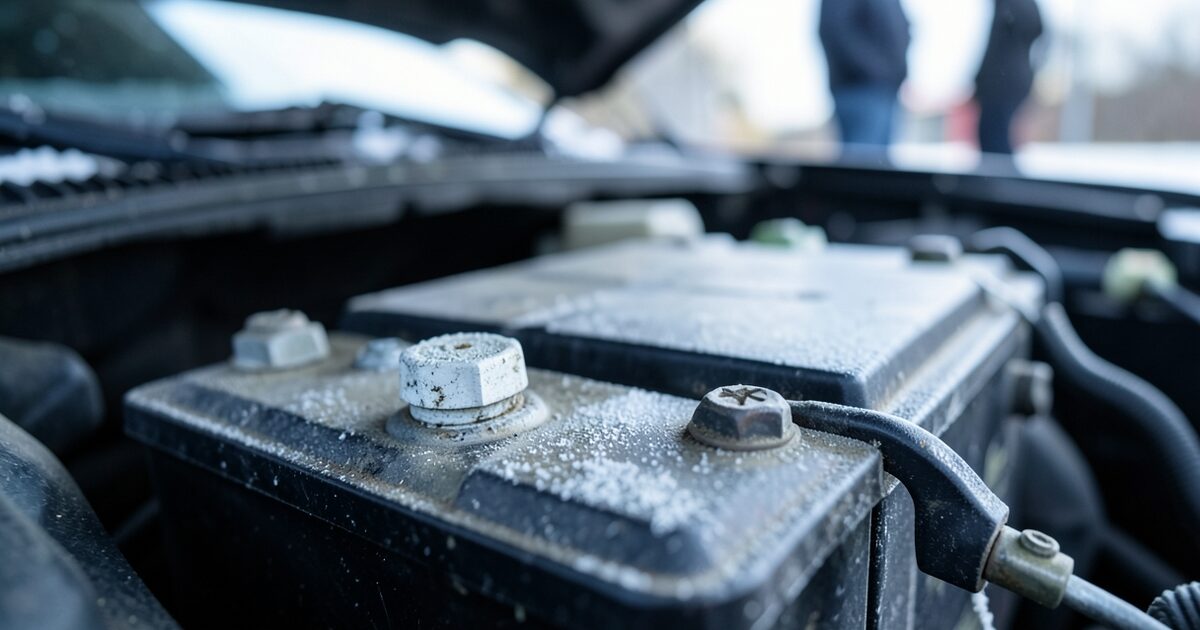
A car battery that starts the engine without trouble in October can refuse to turn over on the first morning that drops below freezing. Usually the battery was already weakened, and the cold removed the margin it needed. For most US drivers the question is practical: how do I know a cold weather car battery will start the car this winter, and what do I do if it does not?
The short answer is to test the battery and check its age before the first hard freeze, clean the terminals, and keep a safe jump-start order in mind. A battery that is four years old or more, or one that cranks slowly on a mild day, deserves a load test before winter. The sections below go through the checks in the order that makes sense in a driveway.
Why a cold weather car battery loses starting power
A lead-acid battery makes electricity through a chemical reaction, and that reaction slows as the battery gets colder. At the same time, cold thickens engine oil, so the starter has to turn a stiffer engine with less power available. A healthy battery usually covers that gap. A tired one often does not.
Battery makers commonly describe a large drop in usable starting power around freezing, and a much bigger drop near 0°F. The exact figure depends on the battery's age, its state of charge, and its cold-cranking amps rating, so treat any single percentage as a rough guide. The practical point is that a battery that seemed fine at 60°F may have too little left at 10°F.
How old is too old for a car battery?
Most conventional car batteries in the US last roughly three to five years. Heat shortens that life, which is why hot states such as Arizona and Texas often see earlier failures, while cold winters hit the starting power of older batteries hardest. Age is the fastest way to decide whether a test is worth an afternoon.
Look for a date sticker on the case. Many manufacturers use a letter for the month and a digit for the year, but the code format varies by brand, so check the key printed on the battery or on the maker's site. If the sticker shows four years or more, schedule a test before the cold arrives, even if the car still starts well in a warm garage.
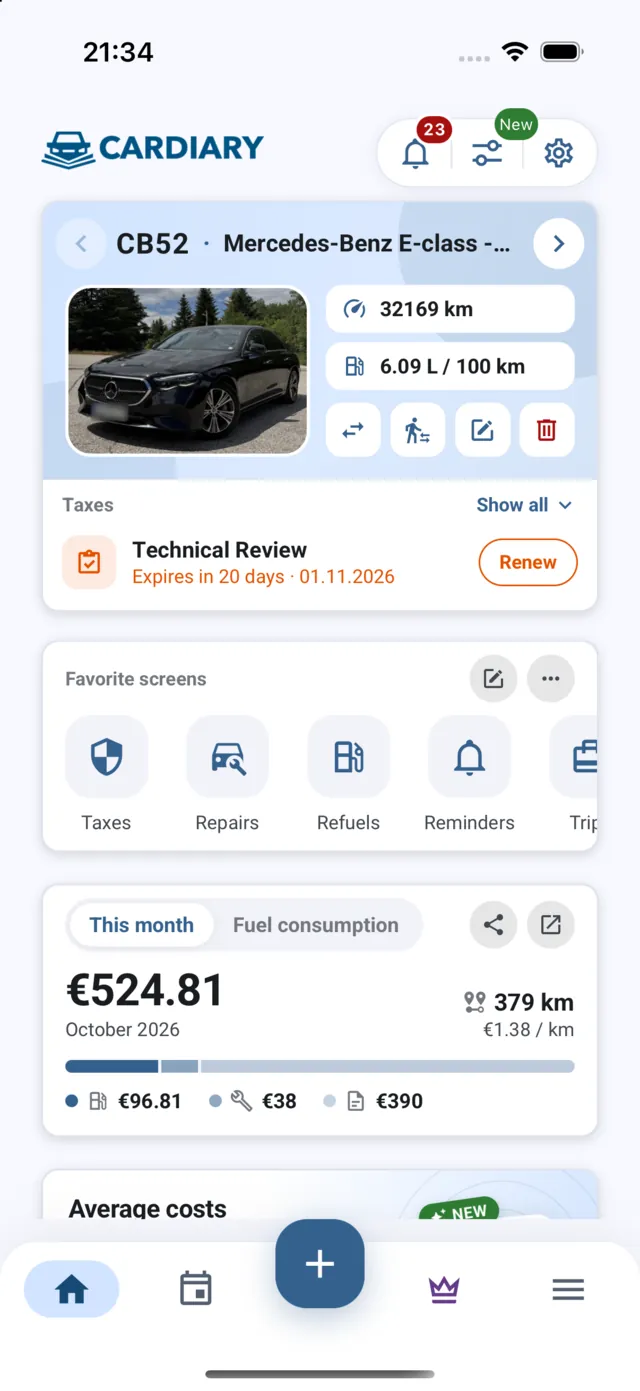
Writing the install date and each test result into a CarDiary service log turns the battery's age from a guess into a date you can plan around, which is more useful than memory on a 10°F morning.
What does a weak battery look like on a cold morning?
Take a hypothetical example. Dana drives a 2019 Honda CR-V with a battery installed in the spring of 2021. On a 45°F evening the engine starts on the first try, but on a 12°F morning the dash lights come on dim, the starter makes a fast clicking sound, and the engine does not crank. The battery is not necessarily dead. It has lost enough capacity that the cold pushed it below the level the starter needs.
Dana's next steps are the same as anyone's. She takes the battery to a parts store for a load test, checks the terminals for corrosion, and jump-starts the car from a neighbor's vehicle. The test shows the battery is near the end of its life, so she replaces it before the next cold snap rather than waiting for a second no-start morning.
How do I test the battery and terminals before winter?
- Ask for a load test. Many auto parts stores offer a free battery test, and a repair shop can do the same with a larger load tester. A load test measures how the battery holds voltage under a starter-like draw, which a simple voltage reading does not show.
- Read the label. Compare the cold-cranking amps (CCA) rating on the battery with the minimum in your owner's manual. A replacement with a lower CCA may start the car in summer and struggle in January.
- Inspect the terminals. Look for white, blue, or green crust on the posts and clamps. Clean it with a wire brush and a baking soda and water solution, disconnecting the negative cable first and reconnecting it last, with eye protection on.
- Check the hold-down. A loose battery vibrates, which can damage the plates and break the connection on rough roads.
- Look at your trip pattern. Repeated trips under about 15 to 20 minutes may never fully recharge the battery, especially in cold weather when the starter draws more energy.
What warning signs show up before a no-start?
A no-start is the last symptom, not the first. Watch for a slow crank on cold mornings, a single click with no crank, dim headlights at idle, or a battery warning light that appears on the dash while driving. Any of these means the battery or charging system has less margin than it should, and the same week is a good time for a test.
- The engine cranks slower than usual for the first few seconds after you turn the key.
- The battery needed a jump more than once in the same month.
- The battery case is swollen, cracked, or leaking. Stop using it and replace it.
- A rotten-egg smell or visible acid around the battery calls for immediate replacement and careful cleaning.
How do I jump-start a car in freezing weather?
Jump-starting is safe when the order is right and the battery is not damaged. A frozen or cracked battery must not be jumped, because it can leak or vent gas. Check the case first, and keep the cars apart so no metal touches between them.
- Park the donor vehicle close enough for the cables to reach, without the two cars touching. Turn off both engines and all accessories.
- Connect one red clamp to the positive post of the dead battery.
- Connect the other red clamp to the positive post of the good battery.
- Connect one black clamp to the negative post of the good battery.
- Connect the last black clamp to unpainted metal on the dead car, away from the battery, such as a bolt on the engine block.
- Start the donor car and let it run for two to three minutes.
- Try to start the dead car. If it does not start after a few tries, stop and have the battery and charging system tested rather than cranking repeatedly.
- Remove the cables in reverse order, black from the dead car first.
Hybrids and some newer vehicles have jump points in a different place, or a 12-volt battery in the trunk. Follow the owner's manual for those models, because a hybrid's high-voltage system is not something to improvise around. After a jump, keep the engine running with at least 30 minutes of driving if you can, so the alternator puts charge back in.
Which mistakes leave a battery flat overnight?
Most overnight dead batteries come from a small drain that adds up, not from one big failure. Dome lights, glove box lights, and a phone charger plugged into an always-on outlet can pull power for hours. A trunk light or an aftermarket alarm with a poor installation can do the same. A battery that is already old has less reserve to absorb that drain.
Another common mistake is parking in a cold garage after a series of short trips and assuming the battery is full. It may be only partly charged, and a partly discharged battery in freezing temperatures is more vulnerable to damage. Running the engine in a closed garage to warm it up is a separate danger because of carbon monoxide, so warm the car outdoors by driving it instead.
Cold weather car battery questions drivers ask
Can cold weather kill a healthy car battery?
A healthy battery usually survives a cold snap and simply starts the car more slowly. Cold exposes a weak battery, but repeated deep discharge combined with freezing can crack the case, so keep the battery charged.
How long should a car battery last in the US?
Most conventional batteries last about three to five years, depending on heat, trip length, and electrical load. Check the date sticker and test the battery once it reaches four years old.
Does a short drive recharge a battery in winter?
Short drives often do not replace the energy the starter used. Plan drives of 20 minutes or more when you can, or use a maintainer charger if the car sits for weeks.
Is it safe to jump-start a car in the snow?
Yes, if the clamps stay off moving parts and the battery case is intact. Keep the connections clean and dry, and never let the two cars touch.