The used electric vehicle market picked up real momentum in August 2026. Cox Automotive, which publishes the monthly EV Market Monitor through Kelley Blue Book, reported roughly 44,350 used EV sales for the month—a 25.9% jump from July and 14.7% above August 2025. At the same time, the average used EV listing price held near $37,441, down 1% month over month but still 8.2% higher than a year earlier. For shoppers who missed the federal new-EV tax credit window, that combination matters: more cars on the lot, and a price gap over comparable gas models that has narrowed to about 7.8%.
Why off-lease cars are filling the lanes
Three-year leases signed during the 2022–2023 EV rush are coming home. Cox Automotive notes that rising off-lease returns are expanding used EV supply just as buyers look for an affordable entry point after new-EV incentives ended. Used EV days' supply fell to 42 in August—the first time this year that preowned electric inventory matched gasoline vehicles on dealer lots. New EV inventory, by contrast, sat only two days above gas-powered stock. Tesla still accounts for close to 30% of the used EV market, followed by Ford, Hyundai, BMW, and Chevrolet, though the mix is widening as more brands' first-wave leases expire.
What $37,441 buys in today's market
The average used EV listing price sits well below the new EV average transaction price of $54,754 recorded in August. Industry data show a meaningful share of sold used EVs still land under $30,000, especially older Nissan Leaf and Chevrolet Bolt examples and high-mileage Tesla Model 3 sedans. A $37,441 budget more often targets a three- or four-year-old Tesla Model Y, Hyundai Ioniq 5, Ford Mustang Mach-E, or BMW i4 with moderate miles. Cross-shopping a similarly priced used gas SUV—think a Toyota RAV4 or Honda CR-V—is where the 7.8% premium shows up on the window sticker, but the running-cost math can flip once you account for home charging.
Monthly energy costs: EPA figures vs. a gas comparator
The U.S. Environmental Protection Agency publishes uniform fuel-cost estimates at fueleconomy.gov. The 2026 Fuel Economy Guide assumes 15,000 miles per year, a 55/45 city-highway split, regular gasoline at $4.15 per U.S. gallon, and residential electricity at $0.15 per kilowatt-hour. Under those inputs, a 2026 Tesla Model 3 Standard at 24 kWh per 100 miles carries an EPA annual "fuel" cost of about $550—roughly $46 per month. A comparable 30-MPG gas sedan at the same mileage burns 500 U.S. gallons annually, or about $2,075 at $4.15 per gallon—$173 per month.
Scale that to 1,000 miles per month and the gap widens. The Model 3 example above uses about 240 kWh, costing $36 at $0.15/kWh. The 30-MPG gas car needs 33.3 U.S. gallons, or $138 at $4.15. Public DC fast charging runs higher—often $0.40 to $0.50 per kWh depending on the network—so a commuter who cannot plug in at home should budget closer to $96 to $120 per month for the same 240 kWh. The EPA explains at epa.gov/greenvehicles that MPGe ratings include charging losses, which is why label figures reflect what you pay at the wall outlet rather than battery capacity alone.
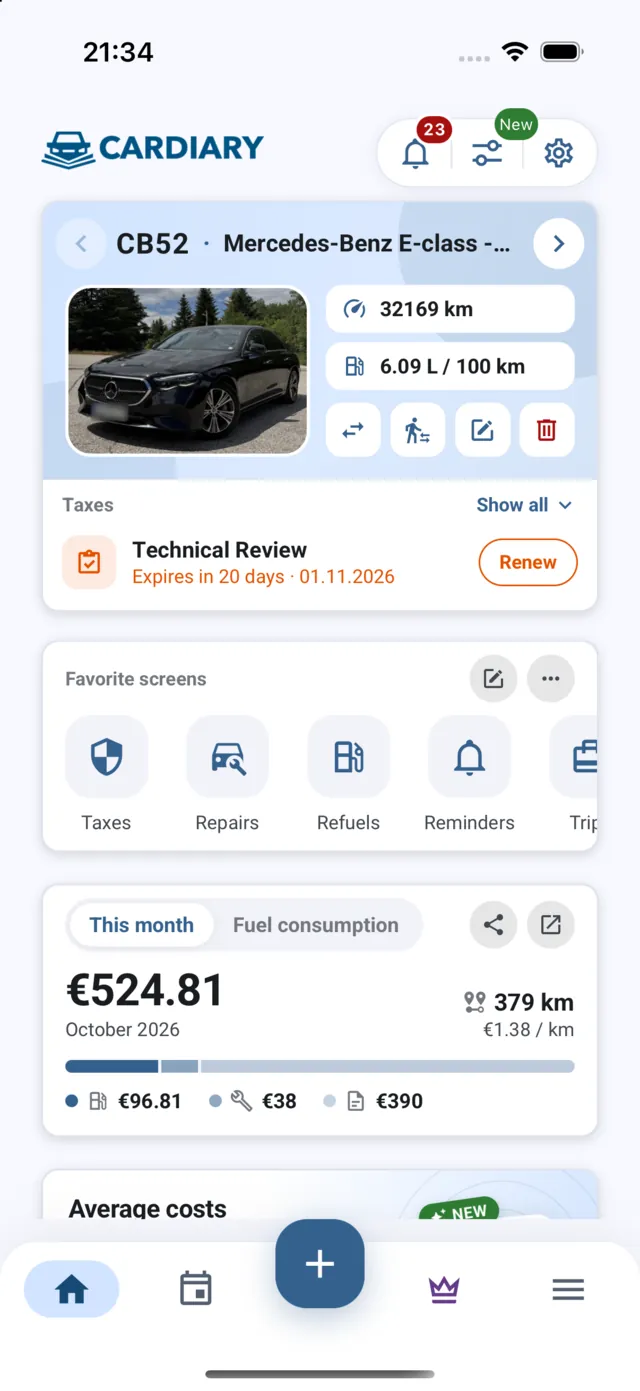
You can model your own commute with the CarDiary MPG and fuel cost calculator by plugging in local gas prices and your actual monthly miles alongside an EPA kWh/100 mi figure from the window sticker of the used EV you are considering.
Insurance, repairs, and battery warranty transfer
Electricity savings do not erase every ownership line item. Insurers often price EV policies higher because collision repairs involving battery packs and specialized body shops cost more than comparable gas-car fixes. Always request quotes on the specific VIN before you buy, not after. Tire wear can also run faster on heavy EVs due to instant torque and higher curb weight.
Most EV batteries carry an original warranty of eight years or 100,000 miles, whichever comes first, and that coverage typically transfers to subsequent owners—verify the in-service date and mileage on the manufacturer's portal. A 2023 lease return with 36,000 miles still has substantial battery warranty remaining; a 2019 model approaching 90,000 miles does not. Open recalls follow the vehicle, not the original buyer. Search the VIN at nhtsa.gov/recalls before signing paperwork.
Registration and inspection after you buy
Transferring a used EV follows the same state DMV path as any other vehicle: title assignment, sales tax, new registration, and proof of insurance. Some states add an annual EV registration surcharge—California, for example, charges a road-improvement fee on zero-emission vehicles—so check your state motor-vehicle agency site for the exact fee schedule. Safety or emissions inspection rules vary by state; if your state requires periodic inspections, note the due date when you register so it does not slip past. The CarDiary registration renewal tracker helps keep that deadline visible alongside your other vehicle dates.
Shopping checklist for an off-lease EV
Start with battery health. Ask the dealer for a state-of-health report or use the onboard display to confirm remaining capacity. Compare EPA range on the original Monroney label with what the car shows at 100% charge today—a large gap signals degradation or heavy fast-charging history. Inspect charging equipment: a included Level 2 home charger can save $300 to $600 over buying one yourself. Confirm whether the car includes transferable free supercharging or if that perk expired with the first owner.
Run the VIN through CarDiary's VIN check to confirm trim, model year, and open recall status match the listing before you put down a deposit. Once you narrow the hunt to two or three off-lease candidates, logging each test-drive odometer reading and local charging estimate in CarDiary beats guessing which listing actually fits your monthly budget.
August's data suggest the used EV aisle is finally behaving like a normal preowned market: more supply, tighter premiums, and prices that respond to inventory rather than hype. For U.S. drivers priced out of new electric models after incentive changes, an off-lease Tesla, Hyundai, or Ford with verified battery warranty and honest range numbers remains one of the most practical ways to cut monthly energy spending—provided you price insurance, registration, and charging location into the deal before you drive home.