Walk into a compact-SUV aisle in September 2026 and the conversation has shifted. Shoppers who used to ask about tow ratings or third-row space are now opening with a simpler question: how many miles per gallon does it actually get, and what will that cost at the pump this month? Hybrids are answering both at once, and dealer data shows they are taking a much larger slice of new-vehicle sales than they did when regular gasoline sat closer to $3 per gallon.
Hybrids are nearly one in five new retail sales
Industry analysts put conventional hybrid market share at roughly 18% to 19% of U.S. retail sales in August 2026, up several percentage points from early 2026. J.D. Power and GlobalData forecast hybrid share at 18.2% for the month, while retail tracking cited by Reuters placed hybrids at about 19% of transactions — briefly touching 20% in May. NADA reported hybrids at 15.7% of all new light-vehicle sales using a broader denominator that includes fleet deliveries. The direction is consistent across methodologies: when pump prices climb, buyers move toward powertrains that stretch a gallon without asking them to change how they refuel.
The pump-price backdrop
According to AAA, the national average for regular gasoline reached $4.43 per gallon on September 17, 2026 — up 16 cents in a week and more than a dollar above the same period in 2025. Crude oil has traded near $100 per barrel amid continued volatility in Middle East shipping lanes. California drivers already face averages above $6 per gallon in many markets, and several Midwestern states sit well above the national figure. The U.S. Energy Information Administration publishes weekly state and regional gasoline prices at eia.gov/petroleum/gasdiesel, which is the official federal reference for retail fuel data.
Monthly fuel math at 15,000 miles per year
Most ownership-cost comparisons start with 15,000 annual miles — about 1,250 miles per month. At the current national average of $4.43 per gallon, here is what EPA combined fuel-economy ratings translate to in real dollars. Figures use combined city/highway MPG from the U.S. Environmental Protection Agency's fueleconomy.gov database; your driving mix and climate will shift results up or down.
- 2026 Toyota Prius (FWD, 57 combined MPG): about 263 gallons per year, roughly $97 per month in fuel.
- 2026 Toyota RAV4 Hybrid (FWD, 43 combined MPG): about 349 gallons per year, roughly $129 per month.
- 2026 Honda CR-V Hybrid (FWD, 40 combined MPG): about 375 gallons per year, roughly $138 per month.
- 2026 Honda CR-V (turbo gas, 30 combined MPG): about 500 gallons per year, roughly $185 per month.
- 2026 Chevrolet Equinox (FWD gas, 27 combined MPG): about 556 gallons per year, roughly $205 per month.
Switching from a 27-MPG gas crossover to a 43-MPG hybrid at national-average prices saves roughly $76 per month — about $916 per year — on fuel alone. The gap widens in high-price states: at $6.00 per gallon, the same move saves roughly $103 per month. That is before any difference in purchase price, financing, or insurance, but it explains why hybrid inventory turns quickly when gasoline spikes.
Why the RAV4 and CR-V define this cycle
Toyota made a structural bet that matters in 2026: the U.S. RAV4 lineup is hybrid-only, with front-wheel-drive models rated up to 47 city / 40 highway / 43 combined MPG on regular gas. Honda still sells both turbo gas and hybrid CR-V trims side by side, which makes the comparison visible on the same showroom floor — the hybrid CR-V FWD carries a 43 city / 36 highway / 40 combined EPA rating, while the turbo gas CR-V FWD is rated 28 city / 33 highway / 30 combined. A buyer cross-shopping within Honda can see roughly $47 per month in fuel savings at $4.43 per gallon without changing vehicle size class.
The Prius remains the efficiency benchmark among mass-market hybrids, at 57 combined MPG for the base front-wheel-drive model. It is not an SUV, but it sets the ceiling for what gasoline-plus-battery technology achieves without a plug — useful context when a dealer quotes hybrid premiums on larger body styles.
Hybrids versus EVs in the current market
Electric-vehicle sales rose modestly from July to August 2026 according to Cox Automotive data, but EV share remains near 6% of new-vehicle sales — far below the hybrid surge. Federal clean-vehicle tax credits expired in late 2025, pulling many purchases forward and leaving EV buyers to face higher out-of-pocket prices today. Hybrids avoid that cliff: they use the same gas-station infrastructure drivers already know, require no home charger installation, and deliver meaningful MPG gains on highway commutes and suburban errand loops where cold weather or apartment parking would complicate EV ownership.
Plug-in hybrids sit between the two. The 2026 RAV4 Plug-In Hybrid offers an EPA-rated electric range for short trips plus gasoline backup for longer ones, but the monthly fuel math above applies most directly to conventional hybrids that never need a charging session.
Inventory pressure and the GM gap
Strong hybrid demand has outpaced supply on some of the best-selling nameplates. J.D. Power noted unusually tight hybrid availability in August 2026 even as share climbed. Reuters reported that General Motors — which prioritized battery-electric development — may not field a U.S. hybrid passenger model until near the end of the decade, while Toyota and Honda hybrid stock moves off lots more than twice as fast as comparable gas-only inventory in some quarters. For shoppers loyal to a brand without a hybrid option, the fuel-cost table above is a concrete reason cross-shopping has intensified.
What to verify before you sign
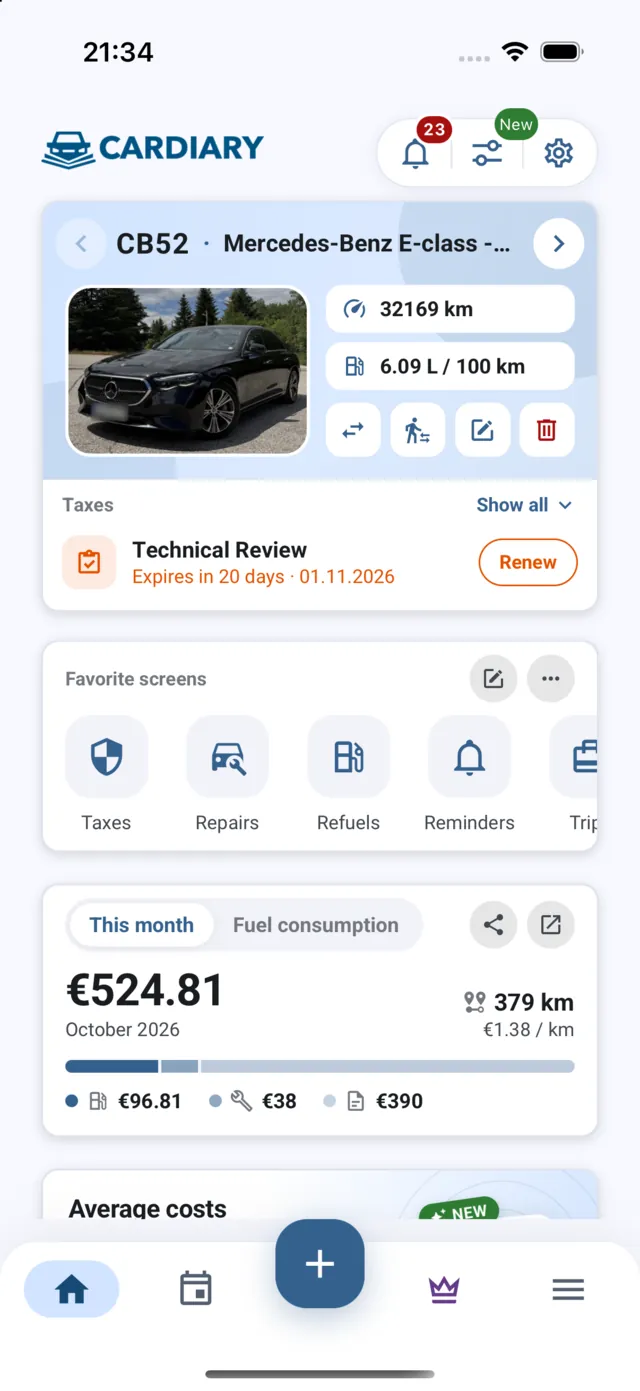
Start with the Monroney label and the exact EPA rating for the trim and drivetrain you are considering — all-wheel drive typically costs one to three combined MPG versus front-wheel drive on the same model. Ask the dealer whether the quote includes markups on high-demand hybrid trims. Check your state's registration and inspection schedule separately; CarDiary can remind you when renewal or inspection deadlines approach, but it is not a government registry. You can plug your current MPG and local price per gallon into CarDiary's MPG and fuel cost calculator to see monthly fuel spend before signing for a hybrid. Finally, run the same calculation at a stress-test price — $5.00 or $5.50 per gallon — so you know the budget still works if crude oil stays elevated through winter.