Honda is pulling forward North American production of its next-generation CR-V hybrid by several months, with updated models scheduled to roll off the line in Ontario, Canada as early as February 2027 and additional assembly capacity following in Indiana and Ohio. The move comes after Honda canceled three North American EV projects and redirected capital toward conventional hybrids—the powertrain type US shoppers are actually buying as gasoline prices climb back toward spring 2026 highs.
What Honda is building—and what is on sale now
The accelerated timeline targets an updated CR-V hybrid built in North America, but the current 2027 CR-V lineup is already in showrooms. Honda lists the gas-powered LX at a $31,520 starting MSRP before destination, while the Sport Hybrid opens at $36,030. With Honda's $1,550 destination charge, a well-equipped comparison looks like this:
- LX (FWD, turbo 1.5L): about $33,070
- EX-L (FWD): about $37,350
- Sport Hybrid (FWD): about $37,580
- Sport Touring Hybrid (AWD): about $44,500
All CR-V trims share a 14.0-gallon fuel tank and run on regular unleaded. Adding all-wheel drive costs $1,500 on most trims and is standard on TrailSport and Sport Touring Hybrid models.
EPA fuel economy: hybrid vs. gas CR-V
The EPA publishes separate ratings for each CR-V powertrain. According to Honda's official EPA fuel-economy guide, front-wheel-drive gas models (LX, EX, EX-L) are rated at 28 city / 33 highway / 30 combined mpg. The Sport Hybrid and Sport-L Hybrid with FWD reach 43 / 36 / 40 combined, while AWD hybrid trims sit at 40 / 34 / 37 combined—roughly 33% better combined mileage than the gas version.
The hybrid uses a 204-hp 2.0-liter four-cylinder paired with two electric motors and an eCVT. The gas CR-V's 190-hp turbo 1.5-liter is less expensive to manufacture but burns more fuel in stop-and-go driving, where the hybrid's electric assist does the most work.
Monthly fuel math at today's US pump prices
AAA reported a national average of $4.44 per gallon for regular gasoline on September 17, 2026—more than a dollar above the same date in 2025 and approaching the year's May peak of $4.56. At that price, here is what 12,000 miles of annual driving costs using EPA combined ratings:
- Gas CR-V LX (30 mpg combined): 400 gallons × $4.44 = $1,776 per year ($148/month)
- Sport Hybrid FWD (40 mpg combined): 300 gallons × $4.44 = $1,332 per year ($111/month)
- Annual savings: about $444
Because every CR-V carries the same 14-gallon tank, the hybrid stretches each fill-up further: a full tank covers roughly 420 miles in the gas LX versus about 560 miles in the Sport Hybrid at combined EPA ratings. Over a year, the gas model needs about seven more fill-ups.
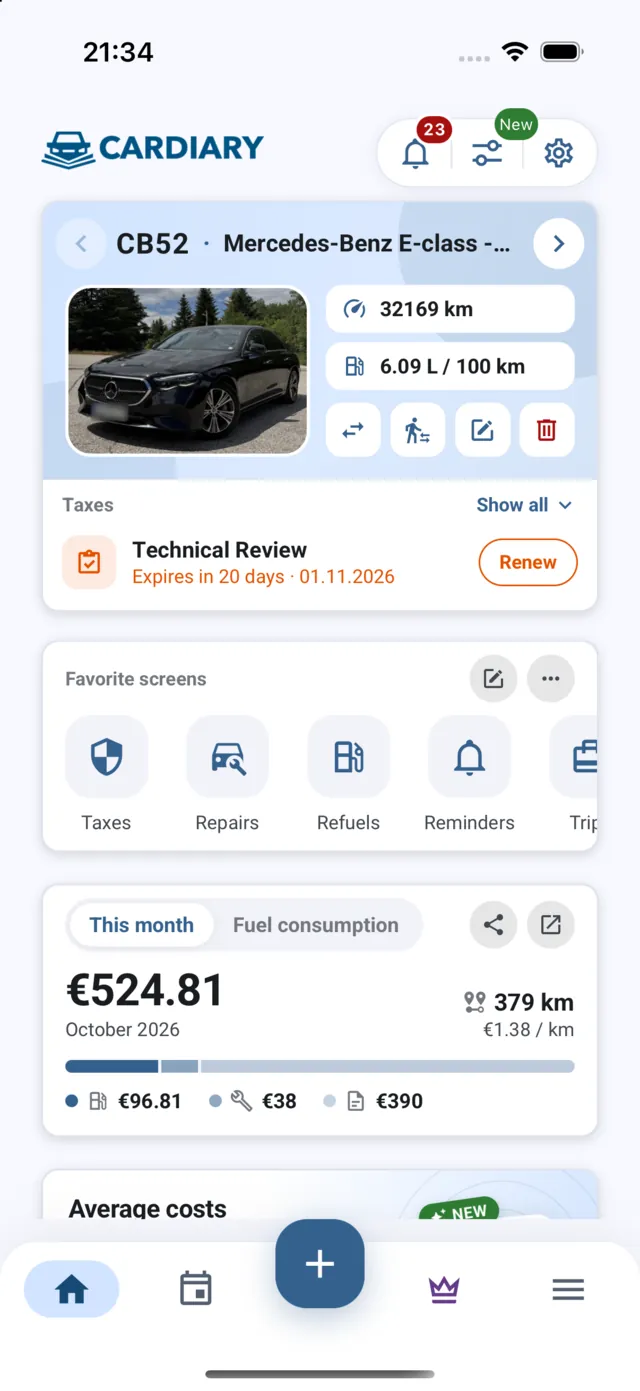
Drivers who cover 15,000 miles annually save closer to $555 per year on fuel. Plug your own commute into the CarDiary MPG and fuel cost calculator if your mix of city and highway miles differs from the EPA combined cycle.
Hybrid price premium and payback
The step from an LX to a Sport Hybrid is roughly $4,510 at MSRP before taxes and fees. Dividing that premium by $444 in annual fuel savings gives a fuel-only payback of about ten years at 12,000 miles per year, or roughly eight years at 15,000 miles. That math ignores finance charges, insurance differences, and resale value—hybrid CR-Vs have historically held value well in strong hybrid demand cycles.
Comparing within the hybrid range, the Sport Touring Hybrid at $44,500 adds features like a power tailgate, wireless charging, and a Bose audio system over the $37,580 Sport Hybrid, but AWD trims lose a few mpg compared with FWD. A driver who rarely leaves paved roads may save more fuel with the front-wheel-drive Sport Hybrid than with the heavier AWD Sport Touring.
Beyond the pump: insurance, maintenance, and taxes
Hybrid CR-Vs carry a more complex powertrain, which can push comprehensive and collision premiums slightly above a base LX—get quotes on the exact trim before signing. Routine maintenance follows Honda's standard schedule: oil changes, tire rotations, and brake fluid checks. Regenerative braking means hybrid owners often replace brake pads less frequently than gas-only drivers, partially offsetting the higher purchase price over time.
Vehicle registration fees vary by state and rarely distinguish between hybrid and gas versions of the same model. Check your state's DMV site for current registration and title fees. If you use the CR-V for business travel, the IRS standard mileage rate is 72.5 cents per mile for January through June 2026 and 76 cents per mile from July 1 through December 31, 2026—see the IRS standard mileage rates page for details. Actual fuel and operating costs still matter when deciding whether the hybrid trim is worth the upfront premium; the mileage rate covers more than gasoline alone.
Who the 2027 CR-V Hybrid fits best
The Sport Hybrid makes the strongest financial case for commuters who rack up city miles—where the 43-mpg city rating matters most—and plan to keep the vehicle long enough to recover the price gap through fuel savings. Suburban families who mostly drive highway miles at 36 mpg may see smaller real-world gains. With Honda expanding North American hybrid output and gasoline still above $4.40 nationally, the CR-V Hybrid sits at the intersection of immediate availability and a production pipeline built for sustained US demand.
Tracking fill-ups and odometer readings in CarDiary gives you a running record of real-world MPG against the EPA's 40 mpg combined figure—useful whether you buy now or wait for the Ontario-built refresh.