American drivers pulling up to green-handled pumps this year are seeing more than a round number on the price board. Retail gasoline has spent long stretches near or above $4 per U.S. gallon as crude markets react to Middle East shipping disruptions, and the U.S. Environmental Protection Agency (EPA) has repeatedly issued emergency fuel waivers to keep stations stocked. One visible result is wider availability of E15—regular gasoline blended with up to 15% ethanol—sometimes priced a few cents below standard E10. The waiver story is about supply chains and smog-season rules; your household budget still comes down to miles driven, real-world MPG, and what each fill actually costs.
What EPA changed for gasoline in 2026
Under normal summer rules, many states restrict gasoline volatility and ethanol blending so that only E10 (10% ethanol) is sold when temperatures rise. EPA’s emergency actions in 2026 temporarily raised the ethanol cap to 15%, aligned Reid Vapor Pressure (RVP) limits for a single national pool, and paused federal enforcement of some state-specific “boutique” fuel recipes. The agency described the goal as stabilizing supply while keeping more fuel grades on the market during an unusual global shock.
The first broad waiver landed in late March 2026, with nationwide E15 provisions taking effect May 1 for most states, as EPA outlined in its public news release. Because the Clean Air Act limits each emergency waiver to short windows, EPA has renewed the policy in rolling 20-day extensions through the spring and summer—details and effective dates are listed on EPA’s Fuel Waivers page. States may still choose whether to enforce their own fuel programs, so a station in one county can sell E15 while a neighboring state keeps stricter rules.
Which vehicles can use E15
E15 is not universal. EPA has approved it for model year 2001 and newer light-duty cars, SUVs, and light trucks when manufacturers do not prohibit it. It remains illegal for motorcycles, heavy-duty trucks, off-road equipment, and any vehicle with an explicit “no E15” label or owner’s manual warning. Flex-fuel vehicles can use E15 and higher ethanol blends where offered.
If you are unsure about a used car, check the fuel-filler door sticker, the owner’s manual, and the VIN-specific guidance at fueleconomy.gov. A quick VIN check before you buy also confirms model year and trim, which matters when a prior owner modified the fuel system.
MPG math: why cheaper cents per gallon can mislead
Ethanol contains less energy per gallon than pure gasoline. Most drivers see a small drop in fuel economy on E15 compared with E10—often on the order of 1–3% in EPA laboratory cycles, with real-world results varying by engine, driving style, and climate. MPG still uses U.S. gallons and U.S. miles; do not compare UK imperial gallon figures from overseas reviews.
Consider a commuter averaging 12,000 miles per year in a vehicle rated 28 MPG on E10. That is about 429 gallons annually. At $4.00 per gallon, the fuel line is roughly $1,716 per year, or $143 per month. If E15 costs $3.92 per gallon—a realistic eight-cent spread when ethanol is cheap—but MPG falls 2% to about 27.4 MPG, annual consumption rises to roughly 438 gallons. Multiplying 438 gallons by $3.92 equals about $1,717, essentially a wash. Savings appear only when the per-gallon discount exceeds the MPG penalty for your actual driving.
Highway-heavy drivers in efficient compacts may barely notice the blend change. Stop-and-go traffic in heavy SUVs magnifies both fuel use and any MPG swing. Towing or rooftop cargo already cuts MPG; switching blends on top of that makes back-of-the-envelope “cheapest pump price” guesses unreliable.
How $4 gasoline hits monthly budgets
Industry analysts often cite U.S. households using roughly 50–60 gallons of gasoline per month. At a $4.00 national average, that is about $200–$240 monthly at the pump—before diesel for a second vehicle or premium grade in a turbo engine. AAA and other price trackers publish daily state averages; use your local number rather than a national headline when you budget.
Rising fuel cost rarely changes a car payment overnight, but it does reshape total cost of ownership. Insurance, registration, maintenance, and depreciation still dominate long-term spreadsheets; fuel is the line item you control every Monday morning. When pump prices jump faster than wages, drivers defer discretionary trips, combine errands, or shop for a more efficient replacement on the next purchase cycle—hybrid interest rises first, full battery-electric switches lag when upfront prices stay high after federal purchase incentives ended.
Practical fill-up habits during waiver periods
- Read the pump handle color and label. E15 is usually marked with a black-and-orange label; confirm it is approved for your vehicle year.
- Do not use E15 in small engines. Lawn equipment, boats, and older cars without approval can suffer fuel-system damage.
- Track one tank at a time. Reset the trip meter, fill with E10, note miles and gallons, then repeat with E15 on the next tank to see your personal MPG delta instead of guessing from brochure figures.
- Watch renewal dates. When EPA waivers lapse, stations may revert to summer-only E10 in some markets; price spreads can disappear overnight.
- Keep receipts if you deduct business miles. The IRS standard mileage rate for 2026 covers fuel and wear in one cents-per-mile figure for qualifying business, medical, and moving trips—it is not tied to which ethanol blend you bought. Use the official rate published by the IRS, not pump prices alone, when you reimburse employees or claim Schedule C driving.
E15, energy policy, and your next vehicle decision
Waiver-driven E15 expansion is a supply-side tool, not a permanent rewrite of fuel standards. Automakers still optimize engines for E10; ethanol producers gain volume when blend caps rise. Environmental groups debate lifecycle emissions separately from the pocketbook question most drivers ask at the pump: “Will this nozzle save me money this month?”
If you are cross-shopping a 2027 hybrid SUV because your current V-6 pickup averages 18 MPG, the relevant comparison is monthly fuel at today’s local prices versus a higher payment on a 32–38 MPG hybrid—not whether E15 saves two cents today. Likewise, used EV prices may look attractive when gas spikes, but home charging access, battery warranty, and insurance quotes still determine whether electricity beats gasoline for your mileage pattern.
Logging fuel the way you log other car costs
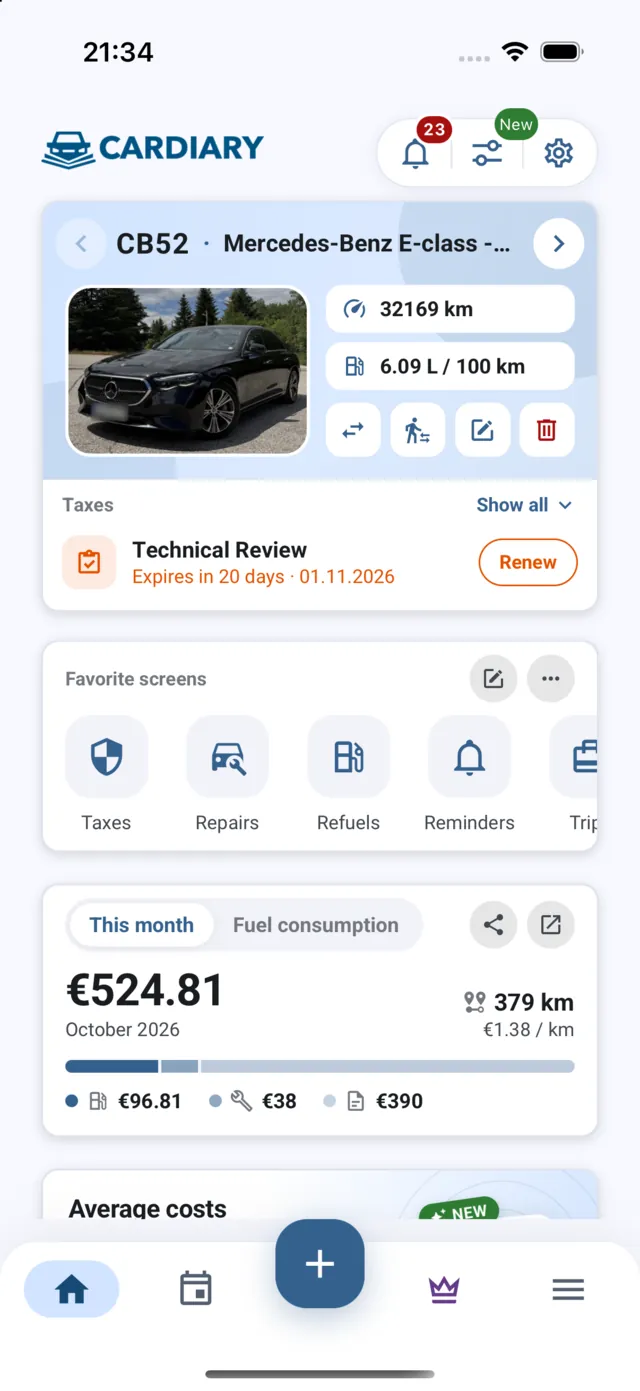
Spreadsheets break when prices change weekly and every family car uses a different grade. CarDiary is a digital vehicle cost and deadline log—not telematics, not a tax filing system, and not a government register—so you can record each fill-up’s gallons, price, and odometer reading and compare monthly fuel spend against prior years without guessing from bank statements alone.
For quick what-if scenarios—moving from 22 MPG to 30 MPG, or testing how a sustained $4.10 average changes your commute—run the numbers in the MPG and fuel cost calculator on car-diary.net using U.S. gallons and your actual odometer miles. Pair that with reminders for registration renewal and state inspection due dates so fixed deadlines do not surprise you in the same month fuel spikes.
Primary sources worth bookmarking
Volatile gas prices will eventually ease, but the habit of matching pump price to real MPG pays off every time blend options, waivers, or regional rules shift. Know what your car can take, measure what it actually burns, and budget with local dollars per U.S. gallon—not assumptions from the last road trip.